
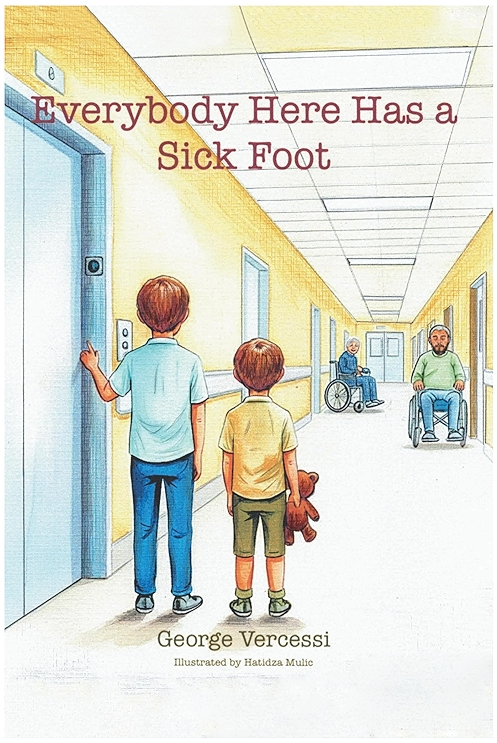
Everybody Here Has A Sick Foot by George Vercessi is a thoughtful and compassionate illustrated children’s book that introduces young readers to the difficult subject of strokes and recovery in a way they can understand.
Illustrated by Hatidza Mulic, the book balances fear, confusion, hope, and healing through the eyes of two young brothers coping with a family crisis.
The story centers on 11-year-old Jamie Roberts, who finds his mother incapacitated while his father and younger brother are away on a camping trip. Acting quickly, he calls 911, and his mother is rushed to the hospital. The sudden emergency creates an atmosphere of anxiety and uncertainty that feels authentic and emotionally grounded.
Their elderly neighbor, Mrs. Farrell, comforts the boys while they wait for news. Later, their father explains that their mother suffered a stroke — described to the children as a “brain attack,” similar to a heart attack but involving the brain and oxygen deprivation. Doctors explain that recovery will take time and that their mother will suffer from aphasia, a condition affecting speech and communication.
One of the book’s strengths is its ability to show how frightening medical terminology can sound to children. After hearing the phrase “brain attack,” one of the boys becomes so frightened he believes he may be having one himself. His father gently reassures him, creating one of the story’s most touching moments. Vercessi effectively captures the anxiety children feel when illness suddenly enters a household.
The illustrations by Mulic complement the narrative well, presenting hospitals and rehabilitation centers in a softened, approachable manner. During visits to the recovery center, the younger brother remarks that “everything is slow — even the elevator,” an observation that subtly conveys the emotional heaviness surrounding rehabilitation.
When their mother eventually returns home, the family faces new frustrations. The boys are eager but feel helpless when her progress seems uneven. She experiences mood swings with long stretches of silence, realities many stroke families experience but which are rarely addressed in children’s literature.
The story takes a hopeful turn when two women who are stroke survivors visit the family to offer practical advice and emotional support. The boys’ mother soon regains the ability to speak and walk independently.
By the conclusion, Everybody Here Has A Sick Foot succeeds as both an educational tool and a heartfelt family story. The book sensitively teaches adults and children about illness, patience, recovery, and the importance of family support.
⸻
Where to buy the book?
You can purchase Everybody Here Has a Sick Foot on Amazon.
⸻
PRIMO Interviews Author George Vercessi
“Everybody Here Has A Sick Foot,” By George Vercessi
The Book Offers Young Readers a Gentle Lesson on Stroke Recovery
Children's books often help young readers understand life's challenges through simple stories and memorable characters. In this interview, author George Vercessi discusses Everybody Here Has a Sick Foot, a heartwarming tale that offers children a gentle introduction to stroke recovery, resilience, and the power of community support.
What inspired you to write Everybody Here Has A Sick Foot, and was there a personal experience that influenced the story?
I was an adult when my late mother suffered an unexpected stroke, but that didn’t lessen the confusion and anxiety I felt. I hadn’t known anyone who had suffered a stroke and certainly knew nothing of its effects on the body or the recovery period and what it entailed. We were a close-knit family, my mother and her two sisters. We were suddenly in uncharted waters, not knowing who to turn to for help nor what to expect of ourselves and others around us.
Stroke recovery is a challenging subject for adults, let alone children. Why did you feel it was important to explain this topic to young readers?
Despite her grit and determination to do all her medical team required of her, each day brought new, and often difficult challenges for us to cope with. It was for that reason that I decided to write the book. If I, as an adult, was having difficulty navigating the aftermath of my mother’s stroke, how challenging might it be for young family members to grasp the significance of their role during the long recovery period. By bringing this book to the attention of readers I hope to lessen the uncertainty and apprehension associated with this debilitating affliction.
The book does an excellent job of showing the fears and anxieties children experience when a parent becomes ill. How did you approach writing from a child's perspective?
Aside from a few short children’s stories I have written I wasn’t sure how to proceed. I simply put myself in the mind of a pre-teen and wrote. I also relied on books for writing for children, members of my writers’ group as well as librarians in the children’s section of our local library for feedback. All were helpful and encouraged me to go forward.
What kind of research did you conduct regarding strokes, aphasia, and rehabilitation to ensure the story was both accurate and accessible?
I relied heavily on my notes taken immediately following my mother’s stroke. I had carried a notebook with me whenever I met with her medical team, who were all happy to share their knowledge. I also attended many rehabilitation sessions with her and read as much as possible on the subject. By the time I set pen to paper, I had acquired an extensive amount of reference material to draw from.
What do you hope children, parents, and caregivers take away from reading Everybody Here Has A Sick Foot?
My wish is that I reach families either before or soon after they experience what I have experienced. It’s a large audience. According to the American Heart Association, fewer people older than 75 are having strokes. However, the incidence of strokes among adults ages 49 and younger in the U.S. has continued to increase during the last 30 years. The Centers for Disease Control and Prevention maintains that each year 795,000 Americans suffer a stroke. That’s the equivalent of one stroke every 40 seconds. Today, with obesity, diabetes and high cholesterol on the rise—all factors leading to a stroke—I believe it is a message that needs to get out.
I had hoped initially to interest pharmaceutical companies to adopt the book as a public service to their customers, but none were interested. Since I earnestly believed there is a need for this information, I self-published it. The book was out only a few weeks, and I have already received positive feedback from adults who said it is helping them and wishing they had it sooner.
You can find out more about George Vercessi, including his background as a captain in the U.S. Navy and other books he’s written by logging on to his web site is https://www.vercessi.com
___________________________________________________________________________________________________________________________________________________

____________________________________________________________________________________________________________________________________________________
Please visit our Books' page to review our latest inventory of books on all things Italian: cookbooks, history, art and culture.