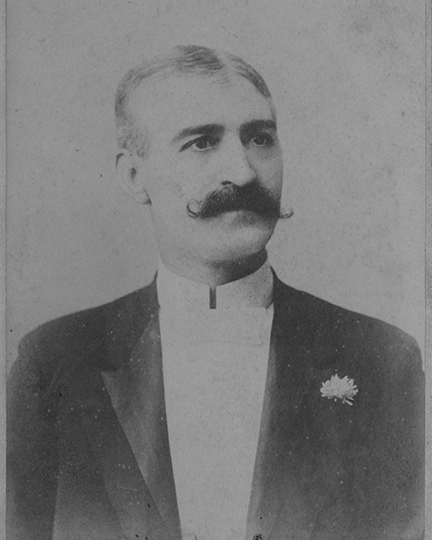
David C. Hennessy, New Orleans Police Chief, Murdered 1891
On the night of October 15, 1890, New Orleans Police Chief David C. Hennessy was walking home when gunmen emerged from the darkness and opened fire.
Struck several times, the 32-year-old Hennessy survived the night but died the following day.
His assassination ignited the darkest episode in Italian American history.
Suspicion immediately fell upon New Orleans' Sicilian community. Nineteen Italians were abruptly rounded up. Nine of them went to trial. Yet, prosecutors failed to obtain a single murder conviction. Six defendants were acquitted, while jurors failed to reach verdicts on three others.
On March 14, 1891, a mob stormed the Orleans Parish Prison and murdered 11 Italians in what remains the largest mass lynching in American history.
Some 14 decades later, historians have concluded most of the Italians executed that night had little or no connection to Hennessy or his murder.
The question begs: If they didn’t do it—then who did?
Former New Orleans police detective and federal prosecutor, Sal Perricone, claims to have the answer.
Perricone turned his investigative experience to the 1891 murder and its aftermath. His 2025 historical novel, Cobblestones: A New Orleans Tragedy, follows Sicilian immigrants through the violent waterfront feud, Hennessy’s assassination, and the subsequent lynching of 11 Italians.
Perricone contends he has uncovered who actually killed the police chief. His claim is now the focus of a crowdfunding campaign, organized by attorney Michael A. Santo, to produce a film based on Perricone’s investigative work and historical presentation. The campaign, supported by the Conference of Presidents of Major Italian American Organizations (COPOMIAO), seeks funds for filming, editing, and archiving the project so that Perricone’s reconstruction of the 135-year-old Hennessy mystery can be preserved.
We now take a look at the possible suspects behind the murder of New Orleans Polic Chief David C. Hennessy?
David C. Hennessy, New Orleans Police Chief, Murdered 1891
______
The Sicilian Feud
By 1890, New Orleans had become a major center of the American fruit-importing business, particularly the trade in bananas and other produce arriving from Central America and the Caribbean. Control of unloading and transporting cargo initiated a violent rivalry between the Provenzano and Matranga families.
Hennessy was believed to favor the Provenzanos; going so far as to provide information that could damage their rivals, the Matranga family.
If Hennessy was going to hurt the Matrangas, perhaps someone associated with them decided to eliminate him.
It remains the most familiar explanation for his assassination. Yet, it was never proved.
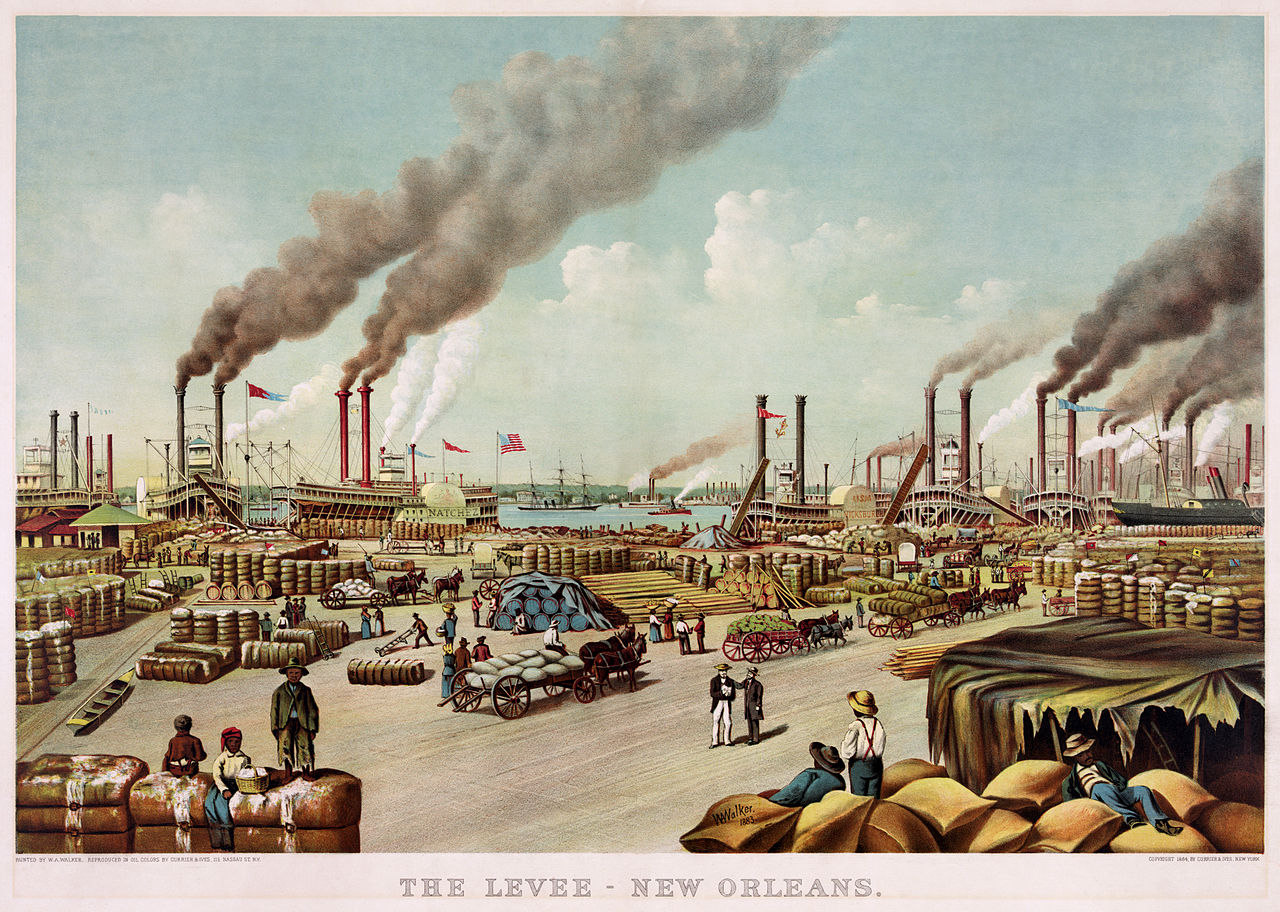
An illustration of 19th century New Orleans waterfront
⸻
Joseph Macheca
Born in New Orleans in 1842 to Sicilian parents, Joseph Macheca was a successful businessman with interests in the city's important fruit trade.
During the Civil War, Macheca served in the Confederacy. During Reconstruction, he participated in the turbulent politics of the city. He was one of many Confederate veterans who attacked white and black Republican legislators in the 1874 Battle of Liberty Place.
By 1890, Macheca was a prosperous and influential member of New Orleans' Italian community.
Prosecutors believed he was connected to the conspiracy against Hennessy. Their theory was not necessarily that Macheca personally fired upon the police chief, but that he may have participated in arranging the assassination.
Although a jury acquitted Macheca, he was lynched, along with 10 others, that fateful night in 1891 in New Orleans.
The 11 men murdered in the parish prison are sometimes collectively portrayed as members of a Sicilian criminal organization.
Some had connections to the commercial and political world surrounding the Sicilian factions. Others were ordinary working men and merchants whose supposed connection to a vast conspiracy was far less convincing.
Arrested for Hennessy’s murder, a number of Italians were acquitted while some, among them, had to face retrials because of hung juries, while others had not been tried at all.
Yet on March 14, vigilante justice made no such distinctions. These Italians, accused of Hennessy’s murder, were executed outside the jail.
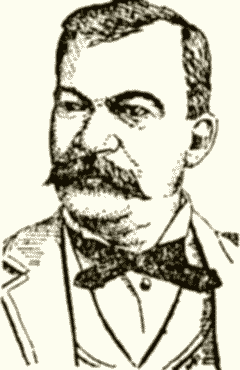
Joseph Macheca
______
What If the Killer Wasn't Italian?
Hennessy's murder may have had little—or nothing—to do with the Italians who were subsequently prosecuted.
As police chief, Hennessy was associated with Mayor Joseph Shakspeare's attempts to reform New Orleans. Hennessy's policing threatened gambling establishments, vice operators, political interests, and individuals accustomed to doing business with a less aggressive police department.
Hennessy also had enemies within law enforcement.
_____
Thomas Devereaux
Years before becoming chief, Hennessy had been involved in an extraordinary confrontation with Thomas Devereaux, New Orleans' chief of detectives. In 1882, Hennessy shot and killed Devereaux. Hennessy claimed self-defense and was ultimately acquitted.
A 1991 statement entered into the Congressional Record argued that Hennessy may have recognized his assassins as people connected to Devereaux. Policemen killing each other in New Orleans was not uncommon, especially after the Civil War. Law enforcement was increasingly staffed by Union veterans during Reconstruction. Many among the political and business class of New Orleans, who fought for the Confederacy, resented what they saw as Northern occupation of the city by way of the police. Hennessy's father fought on the side of the North in the Civil War. He served in the city police department and was killed by a fellow officer—Arthur Guerin.
The right question to ask some 135 years later—Could a relative or close friend of Devereaux’s have killed Hennessy as an act of vengeance? Was Hennessy's murder the result of violent factions withing the police department of New Orleans?
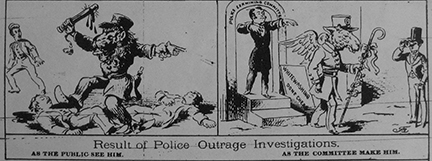
A newspaper cartoon captures the growing controversy over police brutality in 19th century New Orleans
______
The Mysterious Billy O'Connor
A former New Orleans policeman, Billy O’Connor had been with Hennessy shortly before the assassination. After Hennessy was shot, O'Connor became an important source for the claim that the dying chief blamed Italians for the attack.
According to the famous version of events, Hennessy identified his attackers collectively with an ethnic slur.
Yet Hennessy never supplied the name of a particular killer.
Strange, prosecutors did not call O'Connor as a witness at the murder trial.
Nor did they call another potentially important witness, a security guard at Hennessy's residence who was wounded during the attack.
Why?
It is one of several peculiarities surrounding the case of Hennessy’s murder.
______
Dominick O'Malley
An Irish American private detective, Dominick O’Malley became deeply involved in the defense of the Italians accused of murdering Hennessy. After the trial, a grand jury accused him of involvement in improper attempts to influence the proceedings, including prospective jurors.
There is no established evidence that O'Malley participated in Hennessy's assassination.
Yet, with a 135-year-old cold case, O'Malley remains a figure worth examining—not necessarily as a killer, but as someone who may have possessed important knowledge about the political and criminal networks surrounding the case.
_______
An Unsolved Murder
Rather than starting with the assumption that Sicilians killed Hennessy, investigators could ask who knew Hennessy's route home, who knew what he intended to reveal, who had access to professional gunmen, who benefited from his removal, and who benefited from the destruction of prominent Italians moving up the political ladder of New Orleans.
The tragedy of the Hennessy affair is actually two mysteries intertwined.
The first is the murder of a young New Orleans police chief. The second is how an unsolved assassination became justification for collective vengeance against Italian immigrants.
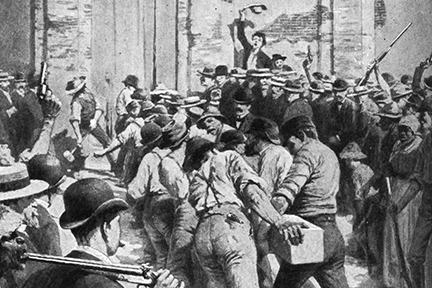
A drawing depicts the lynch mob breaking into the jail holding the Italians in New Orleans
_____
Editor's Note:
The crowdfunding campaign to support a film based on Detective Sal Perricone’s research, into who really killed Chief Hennessy, can be accessed here:
https://www.gofundme.com/f/fund-the-film-uncovering-a-historic-tragedy
Detective Perricone’s book, “Cobblestones” can be purchased here on Amazon
https://www.amazon.com/dp/B0FCNHY84R?lv=shuf&channelId=500&plpRedirect=mhFallback
Instrumental in obtaining a formal apology from New Orleans of the mass lynching of Italians, Michael Santo is a principal behind a new film to identify the true murderer of Chief Hennessy. His web site is: https://santolawgroup.com/about/
The web site for the Conference of Presidents of Major Italian American Organizations:
https://copomiao.org
READ HERE THE NEW EDITION - FIRST 2026 PRIMO
—————————————————————————————————————————————————————————————————————————————
Please visit our DVDs Page to shop our latest collection of DVDs on all things Italian: Films from Italy's Golden Age, Documentaries on Italian American life, ancient Rome, and religion.
Please visit our Books' page to review our latest inventory of books on all things Italian: cookbooks, history, art and culture.
Other articles to read...