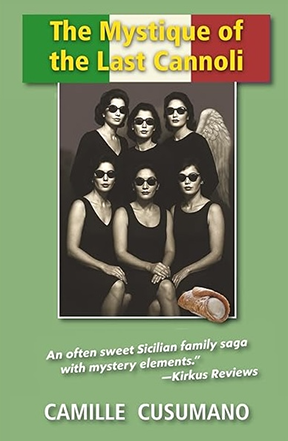
Camille Cusumano’s The Mystique of the Last Cannoli is a richly textured novel of a Italian American family that blends humor, memory, spirituality, Old World tradition, and mystery into a heartfelt story set largely in Elizabeth, New Jersey. Rooted in Sicilian heritage, the novel succeeds as an engaging narrative on memory, grief, and cultural identity.
The story centers on Carmela Donitella, the youngest daughter in a sprawling Sicilian American family headed by Vincent and Magdalena Donitella. Carmela narrates much of the novel in a lively first-person voice that is observant, sentimental, and often humorous. Through her eyes, readers are brought into the crowded kitchens, family arguments, rituals, and ambitions of an Italian American household shaped by love and hardship.
At the symbolic center of the novel is the “Last Cannoli,” a pastry preserved in the family freezer since 1941, the year Vincent and Magdalena married before Vincent departed for World War II. What might initially sound whimsical gradually becomes one of the novel’s most moving symbols. The frozen cannoli represents continuity, remembrance, luck, sacrifice, and the stubborn determination of families to preserve the past against the erosion of time.
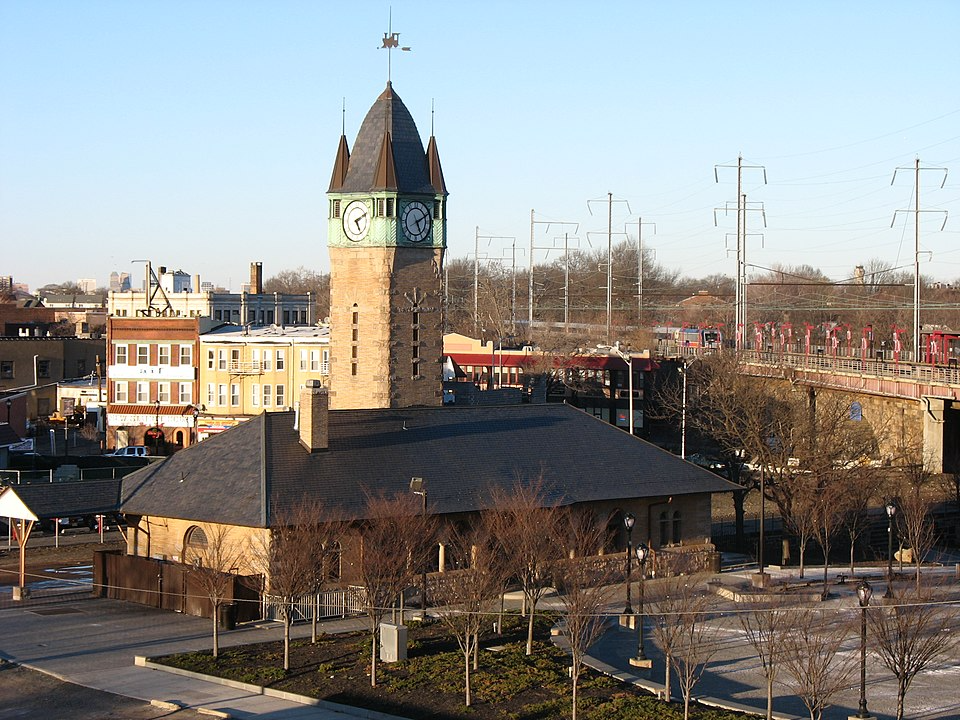
The depot in Elizabeth, New Jersey—where the book is based—is a historical landmark
Cusumano handles this symbolism beautifully. Early in the novel, Carmela describes the cannoli as “sacred with time,” a confection that survives for decades while preserving the emotional memory of the family itself. In many ways, the cannoli becomes a vessel carrying grief, hope, and ancestral memory across generations. The novel’s plot gains momentum through Vincent Donitella’s dream of purchasing and restoring the abandoned Mariners Mansion in order to establish an orphanage. He is portrayed as compassionate, idealistic, and deeply guided by faith. Yet his dream is endangered by local criminals who blackmail him through stolen contraband connected to his modest produce stand business. Determined to save her father’s vision, Carmela recruits her older sisters — humorously referred to as the “Sister Mob” — to help untangle the scheme and somehow raise the money needed to restore the mansion.
Cusumano balances the novel’s suspenseful elements with warmth and comedy. There is a genuine affection in the way she portrays the Donitella family. One of the book’s greatest strengths lies in its dual narrative structure. Alongside Carmela’s narration are italicized chapters conveying the inner reflections and experiences of her mother Magdalena, particularly following the devastating death of her daughter Madeleine in 1970. These passages provide the novel with emotional and spiritual depth. Magdalena’s subsequent journey to Sicily transforms her. The homeland of her ancestors awakens in her a more independent and reflective sense of self while reconnecting her to ancestral roots.
The alternating perspectives work remarkably well. Carmela’s narration provides immediacy and youthful energy, while Magdalena’s voice introduces melancholy, wisdom, and philosophical reflection. Together they create a multi-generational portrait of women navigating loss, family expectations, faith, and personal transformation.
Cusumano’s prose is thoughtful and often filled with unique epiphanies about memory, family, and identity. She captures the emotional texture of Italian American life without romanticizing it. Her New Jersey neighborhoods feel lived-in and authentic, populated by parish culture, old-country traditions, ambitious dreamers, and flawed but deeply human characters.
The author’s literary background is evident throughout the novel. Cusumano, who has written for major publications including The New York Times, The Washington Post, and National Geographic Traveler, brings a polished literary sensibility to the story while maintaining warmth and accessibility.
Ultimately, The Mystique of the Last Cannoli is a novel about preserving what matters most — family memory, cultural roots, and hope itself. Camille Cusumano has crafted a moving and original work that will resonate strongly with readers interested in Italian American heritage, women’s voices, and stories that bridge America and Sicily across generations.
⸻
Where to buy the novel?
You can purchase The Mystique of the Last Cannoli and browse other books for sale by visiting Camille Cusumano’s web site: https://www.camillecusumano.com
⸻
Primo Interview
CAMILLE CUSUMANO
Author of The Mystique of the Last Cannoli
In her novel The Mystique of the Last Cannoli, author Camille Cusumano weaves together family history, Sicilian tradition, mystery, and memory into a richly textured story set in Italian American New Jersey. We recently spoke with Camille about the inspiration behind the novel, her own family heritage, and the symbolism of the “Last Cannoli” that lies at the heart of the story.

What inspired you to write The Mystique of the Last Cannoli, and how did the idea for the story first come to you?
In 2000, I published its predecessor, The Last Cannoli (Legas). I thought that was enough. But I had a letter from 1985 from my father writing me that he wanted to adopt ten children, six girls and four boys, just like the ten he and Mom had successfully launched. They had already adopted two boys from Kosovo (temporarily). The Last Cannoli ends in 1985, so I chose that year, and the month of November, to situate the entire narrative. The new novel is a follow-up but not necessarily a sequel, built around the fictional father’s empty-nest syndrome and wanting desperately to start an orphanage. You can read the books in any order or separately. The Last Cannoli is more “character-driven”—you get a closer portrait of each family member. The Mystique has the same characters, appropriately aged, and is more plot driven.
Italian food and family traditions play an important role in the novel. How much of the story draws upon your own Italian heritage and experiences?
One hundred percent! All four of my grandparents emigrated from Sicily in the 1900s, three of them through Ellis Island. All landed in New Jersey, eventually, Elizabeth, NJ, where the novel takes place. The novel grew out of things I understand deeply big Sicilian families, family myths, sibling loyalties, old-country codes, and the way food can carry love, power, memory. Writing the novel felt less like invention and more like “organized memory.”
The title immediately captures attention. Without giving away any spoilers, what is the significance of "the last cannoli" and why is it central to the story?
Sometimes the last cannoli are never just dessert. The last cannoli became “sanctified,” or endowed with lucky-charm power, in the first novel. It became a sort of talisman through a tale Vincent, the father used to tell. In the follow-up novel, the “last cannoli” has gained even more in stature and its lucky magical power simply through handed-down family tales. Growing up in my big family, Thanksgiving (which is where the Mystique ends) was a huge extended Italian American feast (still is somewhat). That was the only time of year we had cannoli—from Bella Palermo Bakery, still in Elizabeth, NJ. So, I still view the cannoli with a certain reverence and hold it elevated above other pastries. I allowed Carmela, the narrator to speak this for me. (BTW, I’m the fifth of ten, not the baby!)
Many readers enjoy novels that transport them to another time and place. What aspects of Italian American life, culture, or history were you most excited to bring to life in this book?
I was excited to inject the Sicily chapter—where Magdalena, the mother, relates her solo visit there. I’ve written many travel stories about my visits to Sicily, so that chapter grew out of some of them. My father repeatedly reminded us kids that Sicily was crisscrossed or settled by almost every culture, from the Greeks, Phoenicians, Carthagenians, Romans, Byzantines, Arabs, Normans . . . on and on he would rhapsodize. Hence, a richly layered civilization. I say my family are “pure Sicilians” and that’s an oxymoron! I liked injecting some Sicilian dialect, with the help of native Sicilian cousins, and then having Carmela say, although she and her siblings were not taught the language, we kids understood anyway. That’s the way it was.
You've written several books over the years. Where does The Mystique of the Last Cannoli fit into your body of work, and what do you hope readers will take away after turning the final page?
The Mystique of the Last Cannoli is like the latest “new-born child,” getting all my attention now, as the previous ‘children” or books, have been launched. I’ve been doing book presentations here in the San Francisco Bay Area, where I have a broad network of writers, also on the east coast where I have many family members still– one event down the Jersey Shore brought neighbors whom I hadn’t seen in decades. They recognized the fictional Creek Street. I have another two events there, coming in October. Of the books published in the past that still draw readers, there are two in particular: Italy, a Love Story, an anthology I edited. Things Italian are more appealing than ever; and Tango, an Argentine Love Story, a memoir about living in Buenos Aires (2006–10). The latter grew out of my tango passion, and I found there was a lot of Italian heritage, food, and traditions in Buenos Aires.
What do you hope other people will take away from reading your book?
Entertainment for one thing. Also, that families are messy, funny, wounding, generous, unforgettable—and that love often arrives disguised as chaos. One of the pleasures of writing fiction is discovering that every family thinks theirs is unique—and every family is secretly the same in ways. Every family has legends: who sacrificed most, who was wronged, who was favored, who never recovered, who makes the best sauce, and who took the last cannoli.
Editor’s Note: You can purchase “The Mystique of the Last Cannoli” and browse other books for sale by visiting Camille Cusumano’s web site: https://www.camillecusumano.com
___________________________________________________________________________________________________________________________________________________
____________________________________________________________________________________________________________________________________________________
Please visit our Books' page to review our latest inventory of books on all things Italian: cookbooks, history, art and culture.