.png)
Fire almost destroyed all of Notre-Dame in 2019
Our Lady of Paris is back.
Cathédrale Notre-Dame de Paris, on the Île de la Cité, was almost burned to the ground in April 15, 2019. Completely restored in 2024, Pope Leo XIV stepped into the house of worship, during his apostolic journey to France, on September 25, 2026. He was the first pope inside Notre-Dame in the last 18 years. Pope Leo presided over Solemn Vespers and venerated the Crown of Thorns inside Notre-Dame. The following day, he celebrated an outdoor Mass at Place de la Concorde.
The cathedral remains one of the great achievements of European civilization where stone, glass, and sculpture arise inside the soaring Gothic architecture.
The restoration of Notre-Dame called on the best and brightest of European craftsmanship and preservation. Among those who contributed to the enormous undertaking were Italians — an Italian company, an Italian architect, and specialists from Italy whose expertise helped return Notre-Dame to its former glory.
Fire almost destroyed all of Notre-Dame in 2019
_____
Competenza nell'edilizia
One of the most important Italian participants was Mapei, the Milan-based manufacturer of construction materials.
Founded in 1937, Mapei brought modern Italian materials science to one of Europe's oldest and most delicate structures. The company collaborated with French restoration contractors who had been awarded contracts by the public authority Rebâtir Notre-Dame de Paris.

Mapei's assignment was to repair the church’s medieval vaults that the fire had severely damaged.
Heat had weakened mortar between stones, while portions of the upper surfaces were separated and cracked. Restorers were tasked to strengthened the vaults sufficiently enough while preserving the characteristics of medieval masonry.
Mapei supplied a specially formulated mortar based on natural hydraulic lime reinforced with glass-fiber mesh. The mixture was employed on areas of the vaults of the transept, its two arms, the central nave and the choir. Before approval, the solution underwent approximately a year of laboratory and on-site testing before being applied in 2022. Mapei was responsible for training masons and stoneworkers to properly reconstruct the vaults.
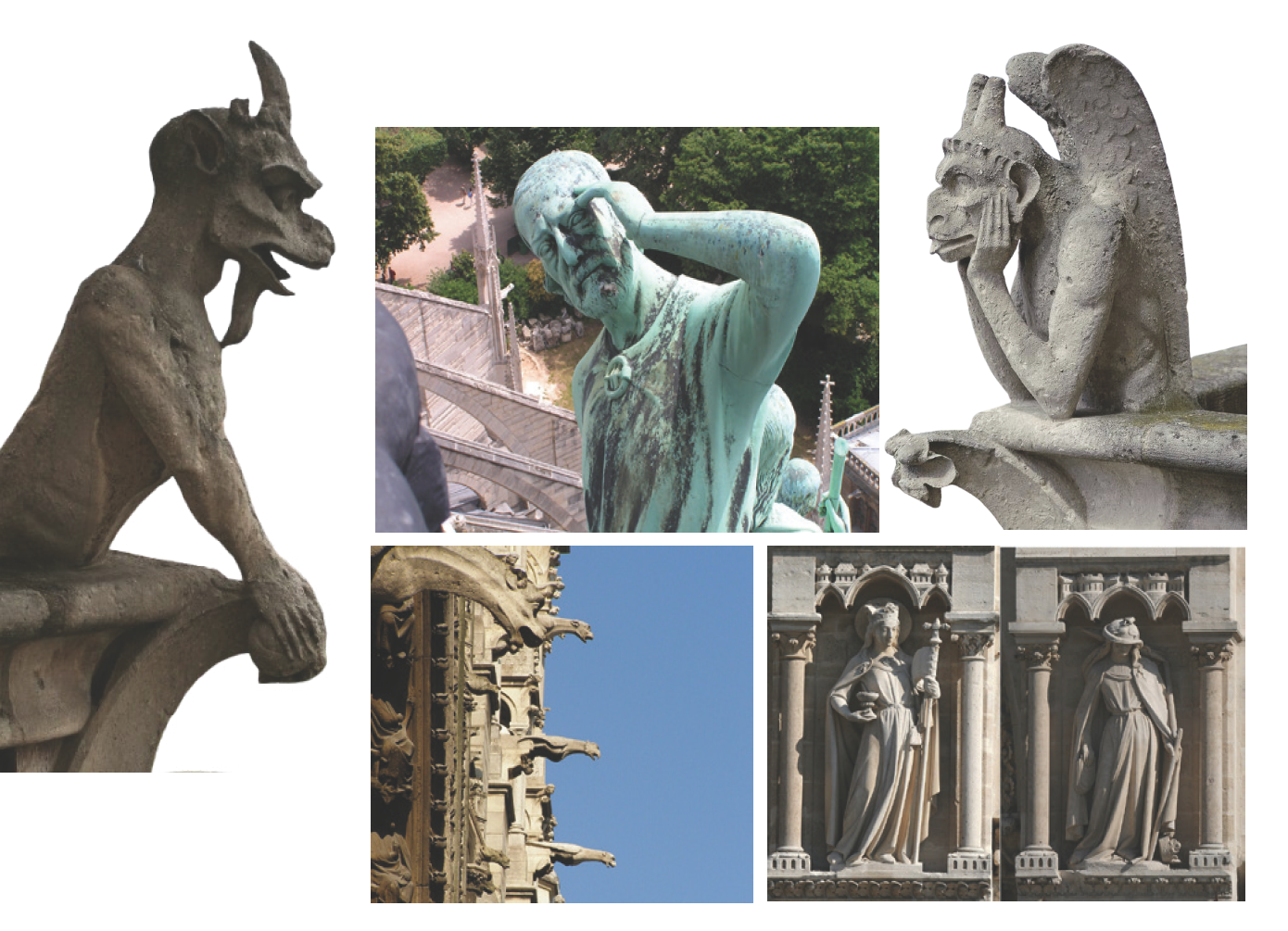
Mapei is an Italian company that helped restore Notre-Dame, a church famous, among other things, for its vast array of statues and deocrative gargoyles and chimera
_____
Competenza architettonica
Professor Carlo Blasi, an Italian architect and specialist in the structural behavior of historic masonry buildings, served as consultant on the restoration of the Notre-Dame Cathedral. He was one of the first people to examine the damage done to the church from the inferno. Blasi was on the scene 15 days after the fire was put out.
Blasi worked alongside the three chief architects responsible for the restoration — Philippe Villeneuve, Rémi Fromont, and Pascal Prunet. His focus was on the stability of Notre-Dame's ancient masonry and reconstructed portions.
Italy's long experience in preserving ancient buildings proved particularly relevant.
Blasi explained that some of Notre-Dame's vaults had collapsed and required reconstruction, while surviving vaults needed reinforcement. Fire had damaged layers of masonry and weakened mortar within joints that had endured for centuries.
He endorsed Mapei's lime-and-pozzolan system to create a reinforcing layer over portions of the vaults.
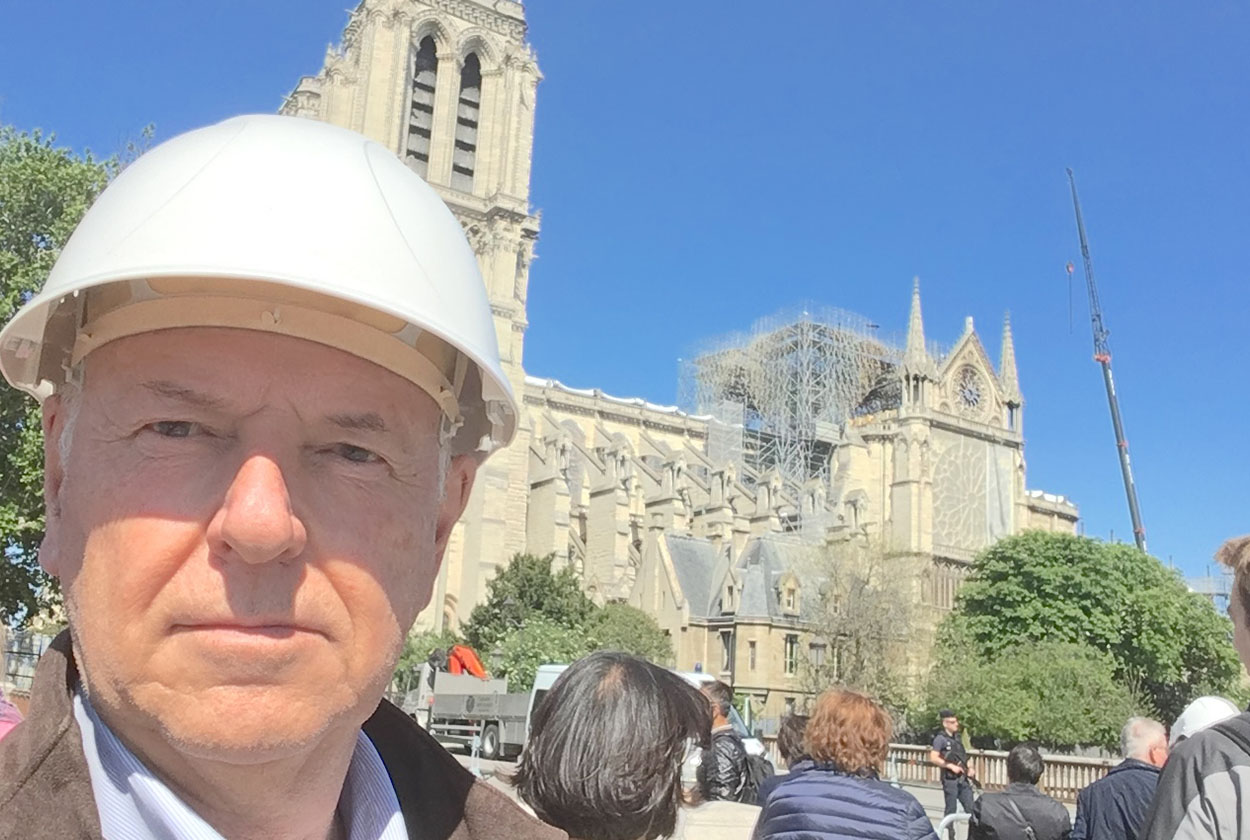
Professor Carlo Blasi was a key advisor to France on the restoration of Notre-Dame
_____
Maestri scalpellini
Among the sculptors associated with the enormous program of restoring Notre-Dame's carved stone decoration was Davide Vanzo.

An Italian stone sculptor working in France, Vanzo was engaged in the painstaking restoration of the cathedral's sculptural elements, including its fantastic stone creatures and architectural ornament.
Stone had to be studied, repaired and, when necessary, recreated using skills descended from the craftsmen who constructed Europe's cathedrals centuries ago.
The distinction between Notre-Dame's famous creatures is worth noting. Gargoyles are not merely grotesque decorations: traditionally they serve as waterspouts, throwing rainwater away from a building's walls. Chimeras, by contrast, are primarily decorative fantastic creatures. Some of Notre-Dame's best-known chimeras date from Eugène Viollet-le-Duc's great 19th-century restoration rather than the medieval construction.
_____
Nostra Signora
Notre-Dame reopened to worshippers and visitors in December 2024, a little more than five years after the fire. The rebuilding was overwhelmingly a French achievement, involving an extraordinary network of architects, engineers, carpenters, stonecutters, sculptors, conservators, and other craftspeople.
Yet within that vast effort was a noteworthy Italian presence.
France was assisted by Italy’s accumulated knowledge in masonry, architecture, engineering, sculpture, and the preservation of historic monuments.
Notre-Dame rises over Paris as a great tribute to the worship of God.
Italians and Americans salute our Catholic brothers and sisters of France in the creation and restoration of Notre-Dame.
“Un capolavoro della Francia, un tesoro dell’umanità.” — A masterpiece of France, a treasure of humanity.
______
Editor’s Note: The official web site for Notre-Dame is https://www.notredamedeparis.fr/en/
The web site for Mapei is https://www.mapei.com
READ HERE THE NEW EDITION - THIRD 2026 PRIMO

—————————————————————————————————————————————————————————————————————————————
Please visit our DVDs Page to shop our latest collection of DVDs on all things Italian: Films from Italy's Golden Age, Documentaries on Italian American life, ancient Rome, and religion.


Please visit our Books' page to review our latest inventory of books on all things Italian: cookbooks, history, art and culture.

Other articles to read...