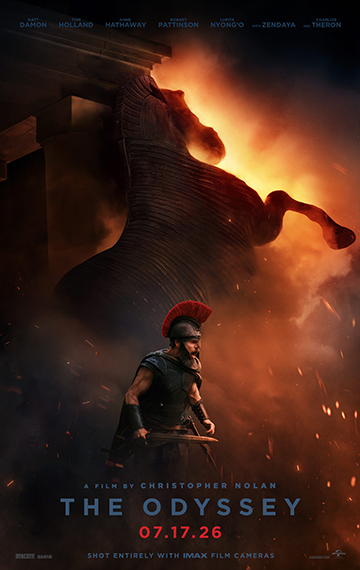
The Odyssey (and its precursor The Iliad) is considered by most literary scholars and historians to be the foundation of western literature.
Homer’s epics, originally told orally over 3,000 years ago, are no strangers to Hollywood adaptations. Films such as Helen of Troy (1954), Troy (2004) and The Return (2024) have all attempted to bring Homer’s ancient poem to the big screen, while countless other films have borrowed his foundational “hero’s journey.” It’s undisputed: The Odyssey is among the most foundational and important texts of all time - a story and journey so iconic and so difficult to adapt, that it risks growing less relevant to modern audiences with each passing year.
⸻
Nolan's Vision
So when Christopher Nolan, one of modern cinema’s most prolific directors, announced his adaptation of The Odyssey three years ago, it immediately intrigued audiences everywhere, myself included. Nolan was fresh off of Oppenheimer (2023), one of the most successful films of the 2020s, grossing close to $1 billion dollars at the global-box office and garnering seven Academy Award wins, including Best Picture. It was clear that Nolan was using his newfound Hollywood capital to make what would be his most ambitious and daunting film yet.
The result, The Odyssey, written and directed by Christopher Nolan, is a cinematic triumph: a fantastical, breathtaking film that re-contextualizes and modernizes Western literature’s oldest story for 21st century audiences. It’s a film that hooks you from its opening crawl and keeps you latched in for nearly three hours, and is a MUST-SEE experience in IMAX and other premium formats. With remarkable cinematography, immersive visual effects, and a propulsive score, The Odyssey is shaping up to be one of 2026’s best films, and is now the front-runner for this year’s Academy Awards.
.jpg)
Christopher Nolan
______
Epic Tale
The film follows Odysseus (Matt Damon) the hero of the Trojan War, as we follow his 20 year journey back to his kingdom Ithaca, his wife Penelope (Anne Hathaway) and son Telemachus (Tom Holland); a journey of which is plagued by gods, monsters, and the hubris of his fellow men. An all-star ensemble includes the likes of Robert Pattinson, John Leguizamo, Jon Bernthal, Lupita N’yongo, Charlize Theron, Zendaya, and other incredible A-list actors. Every performance is remarkable, but the film’s standouts are Matt Damon, who’s squarely in the running for his first acting Oscar, and John Leguizamo, who plays Eumaeus, Odysseus’s blind and loyal servant - a role that, surprisingly, provides the film’s most emotional moments. John Leguizamo is a genuine front-runner for this year’s Best Supporting actor.
At its core, The Odyssey is a modern-day epic in the tradition of classic films such as Lawrence of Arabia or The Lord of the Rings. Each frame is breathtaking, each performance captivating, and its narrative structure takes the oldest story in the world and turns it into an incredibly enthralling and immersive adventure. It’s a visually spectacular film to impress audiences with massive sets, realistic practical effects, and incredible cinematography.
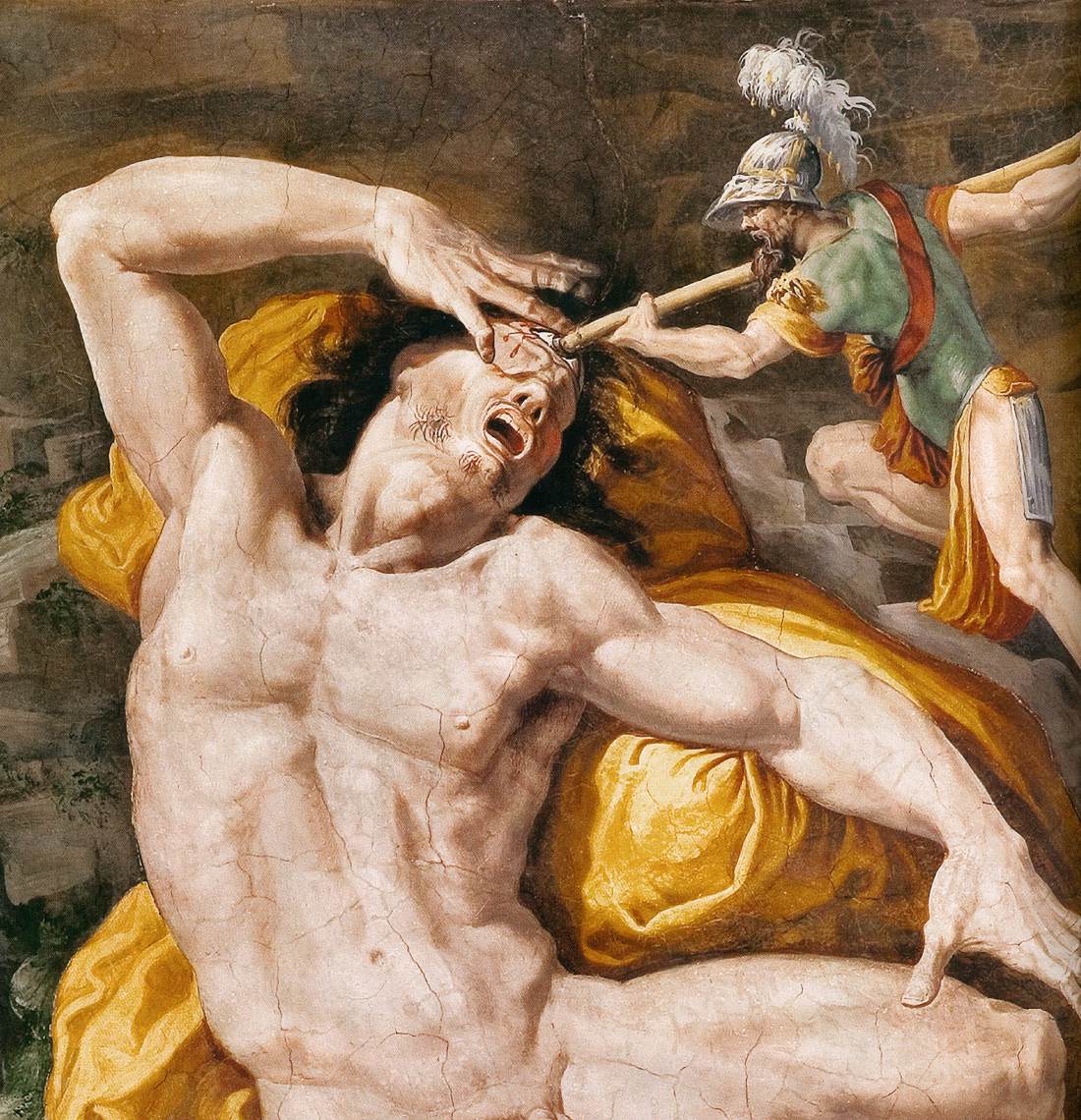
A fresco in Bologna depicts a scene from "The Odyssey"—titled "The Blinding of Polyphemus," by Pellegrino Tibaldi, circa 1527
_____
How Good Is It?
What struck me most about The Odyssey is how it re-contextualizes Odysseus and his journey. Nolan, in his own unique way, serves as a bard of his own, shifting Homer’s poem in subtle ways and asking audiences: is war heroic? Is loyalty deserved? Are we masters of our own fate? These are huge and impossible questions that will leave The Odyssey in audiences’ minds long after they see the film.
Three thousand years after it was first told, Homer’s epic finally has a screen worthy of its scale. Christopher Nolan once again proves one of cinema’s most remarkable directors, providing audiences with a breathtaking spectacle with something urgent to say about endurance, homecoming, and the cost of glory. It’s a rare blockbuster that hits on all fronts, and is in my eyes, 2026’s best film of the year.
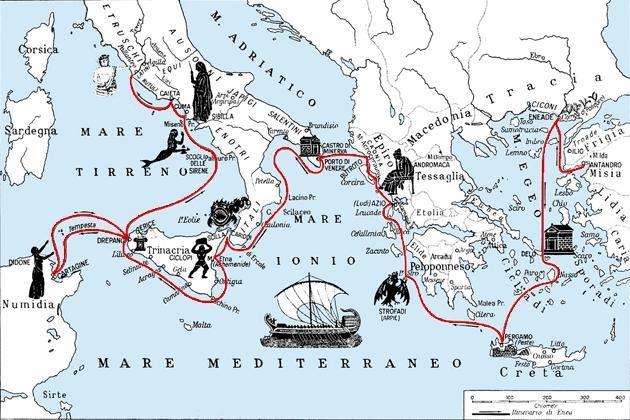
A map shows the journey of Homer's "The Odyssey"—with Italy as frequent stops
_____
Homer’s Italian Connections
A maritime adventure to lead all others, Homer’s The Odyssey takes place throughout the Mediterranean. Settings throughout Italy hosted much of the action of Homer’s classic tale. Here’s a rundown of Italian locations in The Odyssey:
1. Sicily and Southern Italy
Many ancient Greek and Roman writers believed that several of Odysseus' adventures took place in what is now southern Italy and Sicily, then known as Magna Graecia.
Some of the most famous associations include:
- The Cyclops (Polyphemus) – Often linked to the eastern coast of Sicily near Mount Etna. The towering volcanic landscape seemed like the perfect setting for the giant Cyclops.
- Scylla and Charybdis – Traditionally identified with the narrow Strait of Messina. Even today, the currents there can be dangerous.
- The Island of the Sun (Helios) – Some ancient traditions placed this setting in Sicily.
2. Circe
The enchantress Circe lived on the island of Aeaea. Roman authors later identified her home with Monte Circeo, a dramatic promontory about 60 miles south of Rome. The mountain there resembles an island when viewed from the sea, which helped inspire the association.
3. The Sirens
Several locations in southern Italy claim to be the home of the Sirens. One of the strongest traditions places them near the Sorrento Peninsula and the small islands known as Li Galli, off the Amalfi Coast.
4. Greek Colonies
By the time the Odyssey was widely known, Greeks had established numerous colonies in southern Italy, including: Cumae, Taranto, and Sybaris These settlements helped spread the stories of Homer throughout Italy.
5. Influence on Rome
The Odyssey became enormously important to Roman culture. The Roman poet Virgil wrote The Aeneid, in which the Trojan hero Aeneas travels through many of the same waters as Odysseus before eventually reaching Italy to found the lineage that would lead to Rome. In a sense, The Aeneid serves as a Roman counterpart to The Odyssey and The Iliad, weaving Homeric traditions directly into Italy's legendary origins.
_____
Before Christopher Nolan…Italy Produced a Version of “The Odyssey”
So Did NBC Starring Armand Assante
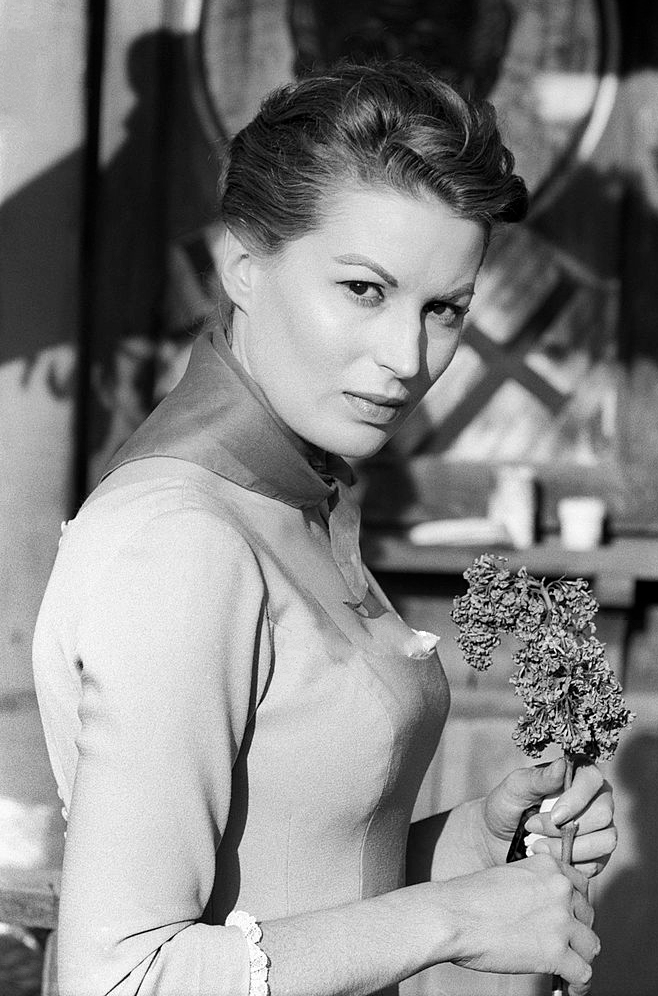
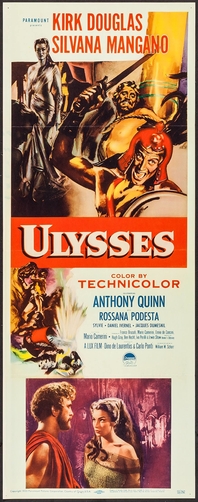
The first major international adaptation arrived in 1954 with Ulysses, directed by Italian filmmaker Mario Camerini. Produced by legendary Italian producers Dino De Laurentiis and Carlo Ponti, the film was a landmark international co-production to introduce Homer's epic to a new generation of moviegoers. Kirk Douglas brought his trademark intensity and athleticism to the role of Ulysses (Odysseus), while the incomparable Silvana Mangano delivered a memorable dual performance as both the faithful Penelope and the enchanting sorceress Circe. Anthony Quinn rounded out the stellar cast as the arrogant suitor Antinous.
The production was especially significant because it represented Italy's growing influence in postwar cinema. Filmed largely in Italy to feature many Italian artists and technicians, Ulysses combined Hollywood star power with Italian craftsmanship. The film's impressive visual effects—created before the age of computers—helped establish Italian style in “sword-and-sandal" epics of the late 1950s and 1960s.
Perhaps no performance was more memorable than Silvana Mangano's (pictured). By portraying both Penelope and Circe, she embodied the two great forces pulling Odysseus in opposite directions: the faithful wife waiting patiently at home in Ithaca and the seductive enchantress tempting him to abandon his journey. It remains one of the most celebrated dual performances in classic Italian cinema.
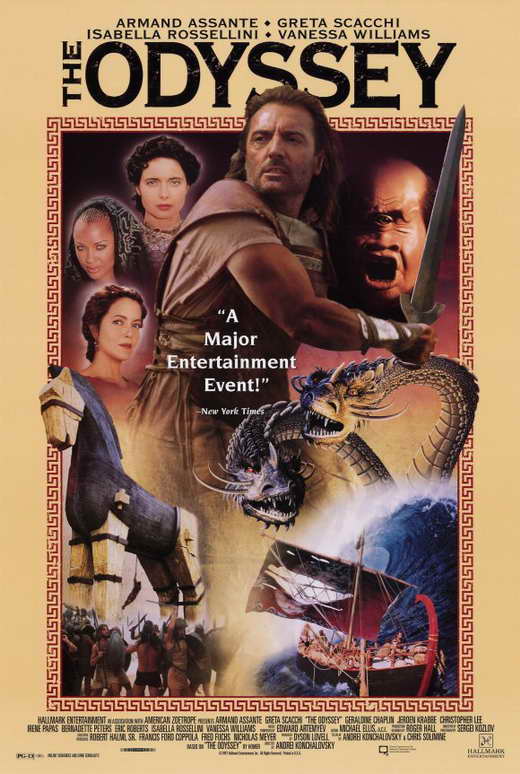
More than four decades later, audiences were treated to another ambitious adaptation. NBC's 1997 miniseries The Odyssey, directed by Andrei Konchalovsky starred the perennial Italian American actor—Armand Assante. This production benefited from a much larger budget to include modern visual effects at nearly three hours of running time. Assante portrayed Odysseus as a battle-hardened warrior whose greatest challenge was not defeating monsters but enduring the trials that separated him from his family for twenty years. Greta Scacchi played Penelope, while Isabella Rossellini appeared as Athena, Bernadette Peters as Circe, and Vanessa Williams as Calypso.
The extended format allowed the 1997 production to include many episodes omitted from earlier adaptations, including a more complete depiction of the Cyclops Polyphemus, the Sirens, Scylla and Charybdis, Calypso, and the final reckoning with Penelope's suitors. Critics praised the miniseries for its sweeping Mediterranean locations and its relatively faithful presentation of Homer's narrative.
_____
Editor’s Note:
The trailer for The Odyssey—https://www.odysseymovie.com
READ HERE THE NEW EDITION - SECOND 2026 PRIMO

—————————————————————————————————————————————————————————————————————————————
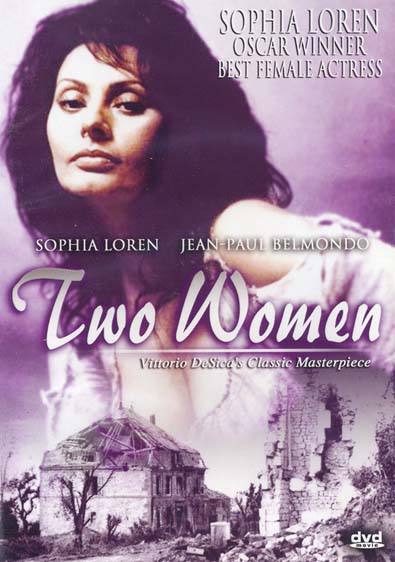
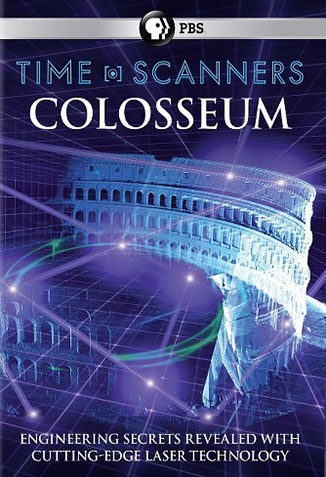
Please visit our DVDs Page to shop our latest collection of DVDs on all things Italian: Films from Italy's Golden Age, Documentaries on Italian American life, ancient Rome, and religion.
Please visit our Books' page to review our latest inventory of books on all things Italian: cookbooks, history, art and culture.


Other articles to read...