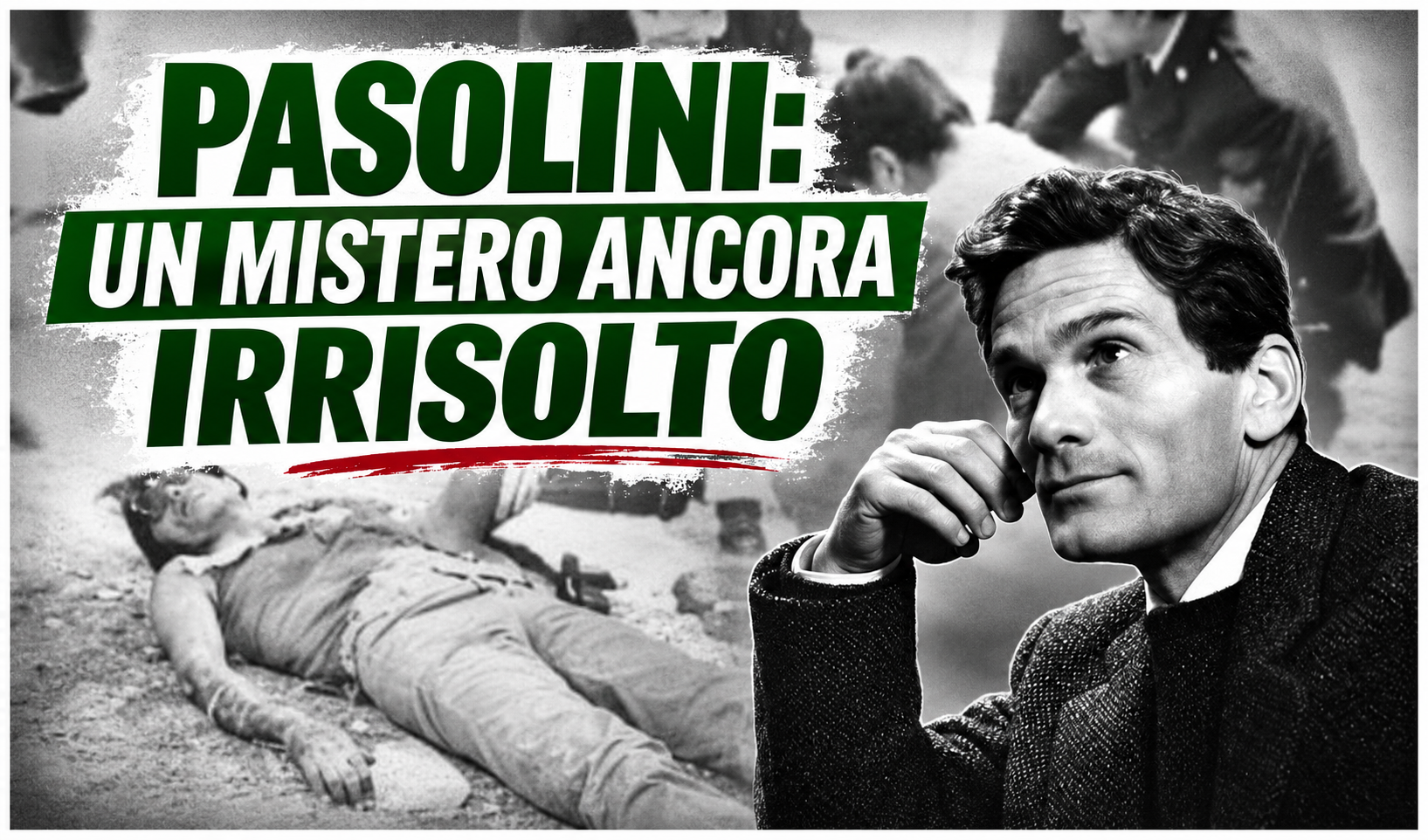
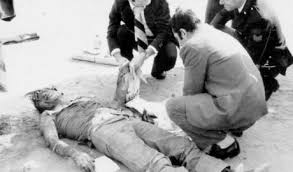
Pier Paolo Pasolini in the foreground of a picture of the crime scene, in 1975, where his corpse lay as police gathered evidence
_____
Was it a male prostitute? Was it the Mafia? Or was it Italy's secret police?
The person or persons who killed Pier Paolo Pasolini, one of Italy's foremost arthouse filmmakers, remain shrouded in mystery.
Pasolini was murdered on the night of November 1–2, 1975, at the Idroscalo in Ostia, a coastal district outside Rome.
Now, more than half a century later, Italian prosecutors have reopened the investigation into one of the country's most enduring and controversial murder cases.
The new investigation, assigned to Deputy Public Prosecutor Silvia Santucci, follows a petition submitted by attorney Stefano Maccioni, who represents the Lazio Journalists Guild, filmmaker David Grieco, and writer Giovanni Giovannetti.
The renewed inquiry is beset by the possible motive in the murder: Was Pasolini the victim of a violent sexual encounter, an organized criminal conspiracy, or a political assassination?
Pier Paolo Pasolini in the foreground of a picture of the crime scene, in 1975, where his corpse lay as police gathered evidence
_____
A Murder That Shocked Italy
One of Italy's most influential and controversial filmmakers, poets, novelists, and intellectuals, Pasolini was a committed Marxist who continually criticized Italian society. His films were meant to be controversial such as Accattone (1961), Mama Roma (1962), The Gospel According to St. Matthew (1964), The Decameron (1971), and his notorious final work, Salò, or the 120 Days of Sodom (1975). Celebrated as a cinematic visionary by some and condemned as a provocateur by others, Pasolini was one of the most polarizing cultural figures in postwar Italy.
Pasolini was only 53 years old when his battered body was discovered on a dirt road near the beach at Ostia. He had been severely beaten and run over by his own automobile.
Police arrested Giuseppe "Pino" Pelosi after they found the 17-year-old driving Pasolini's Alfa Romeo.
Pelosi claimed that a sexual encounter with Pasolini had turned violent. He admitted to police of killing the filmmaker and was subsequently convicted of the crime in 1976.
Unique about the trial's judgment was inclusion of a significant qualification: Pelosi had acted with unidentified accomplices. That conclusion was eventually rejected on appeal, leaving Pelosi as the sole convicted perpetrator.
Pelosi was sentenced to nine years. He served seven. He was released on parole in 1983. In 2005, he recanted his confession. He said that three unidentified men had attacked Pasolini and that he had remained silent out of fear for his family's safety. Pelosi died of cancer in Rome in 2017 at the age of 59.
Many Italians were suspicious that the complete circumstances of the murder had not been established.
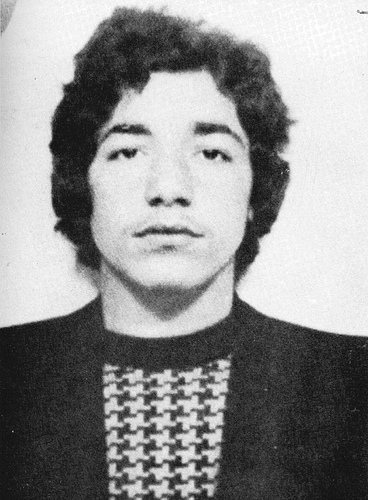
Convicted of the murder of Pasolini was Giuseppe Pelosi
_____
New Evidence?
Beginning in 2008, Stefano Maccioni started challenging the accepted account of Pasolini's death. The attorney claimed in an interview that he was not a fan of Pasolini's work. His involvement was that of a criminal defense attorney examining a cold case. His latest petition, submitted in November 2025 and supplemented in May 2026, claims new evidence to warrant further investigation.
Maccioni directed attention to archival footage from RAI television news broadcasts dating to the original investigation. He believes the material, considered alongside existing evidence, may help establish whether other individuals were present when Pasolini was killed. Another significant issue involves forensic examinations conducted decades after the murder. In 2010, the Carabinieri's scientific unit identified several genetic profiles taken from the crime scene. Some could not be conclusively attributed to Pasolini or Pelosi.
Maccioni argues that the forensic findings undermine the certainty of a lone-assailant. After many attempts, the attorney has finally succeeded in pursuading prosecutors to reopen the case.
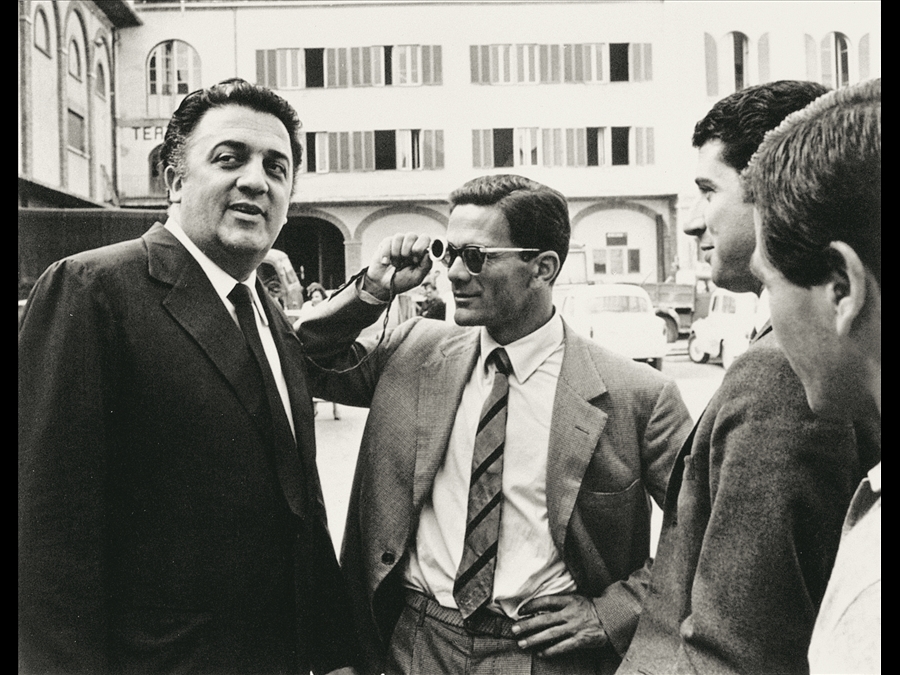
Pasolini, center with sunglasses, is pictured with Federico Fellini
_____
Mafia Involvement?
One of the most intriguing theories surrounding Pasolini's murder involves the theft of film reels from his final motion picture, Salò, or the 120 Days of Sodom.
In August 1975, several reels of film were stolen from Technicolor facilities in Rome. The thieves reportedly demanded a substantial ransom for their return.
According to Pasolini's friend and filmmaking collaborator Sergio Citti, negotiations were conducted through intermediaries. Citti later claimed that Pasolini had received assurances that the stolen material would be returned without payment.
On November 1, 1975, the day before his body was discovered, Pasolini reportedly told Citti that he intended to meet the individuals involved in returning the reels.
The police dismissed any involvement by organized crime when they arrested Pelosi.
Suspicions arose of the Mafia murdering Pasolini in 2022 when Maurizio Abbatino, a former leading figure in Rome's notorious Banda della Magliana criminal organization, testified before Italy's parliamentary Anti-Mafia Commission. Abbatino acknowledged participating in the theft of film reels from orders of a gambling operator, Franco Conte, who knew Pasolini personally.
The Commission subsequently examined the possibility that the theft and murder were connected.
However, Abbatino denied any involvement in the killing, and no court has established that the stolen film reels were used to lure Pasolini to Ostia.
_____
Political Assassination?
In the 1970s, Pasolini became an increasingly outspoken critic of Italy's most powerful institutions. His writings frequently attacked the political establishment with speculative conspiracies of high end corruption and nefarious schemes among government officials, corporate executives, and neo-fascists.
On November 14, 1974, he published an extraordinary article in Corriere della Sera titled "Io so" — "I Know." Pasolini declared he had the names of those responsible for the political violence that had shaken Italy during the Years of Lead.
Italy had experienced a succession of bombings, assassinations, and terrorist attacks involving extremist organizations from both the political right and left. Investigations into some of those attacks exposed troubling connections among extremist groups and elements of the country's intelligence apparatus. Pasolini suggested that powerful individuals operated behind the scenes to provoke violence. Yet he acknowledged he did not possess the evidence necessary to prove his accusations.
Another element in the political assassination theory involves Pasolini's unfinished novel, Petrolio (Petroleum).
The sprawling manuscript explored corruption, political influence, sexuality, and the relationship between Italy's petroleum industry and its government. Particular attention focused on the country's state-controlled energy company, ENI, and its former president, Enrico Mattei, who died in a plane crash in October 1962. Investigators could not prove sabotage. Then, in 1990, the case was reopened to conclude that a bomb was detonated while the aircraft was in flight.
Mattei's successor, Eugenio Cefis, became an important figure among Italian industry, finance, and political power. Some writers and researchers have speculated that Pasolini was uncovering sensitive information about Cefis' influence in Italian government. The suggestion of Pasolini's murder was intended to silence him before he could publish additional revelations.
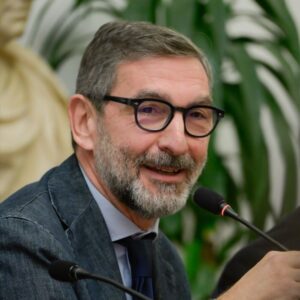
Stefano Maccioni
_____
A Search for the Truth
Satisfied with the prosecutors' decision to reopen the case, attorney Stefano Maccioni calls upon anyone possessing relevant information to come forward. The renewed investigation will depend on identifying additional participants in the crime through credible evidence. The passage of 51 years presents formidable obstacles. Witnesses have died, memories have faded, and physical evidence may be incomplete. Nevertheless, advances in forensic science and the availability of archival material provide investigative possibilities that did not exist in 1975.
Pasolini's murder has long occupied a singular place in Italian history. His death occurred during an era marked by ideological conflict, terrorism, and political turmoil.
The reopening of the investigation demonstrates that Italian authorities are once again willing to examine questions that have persisted for more than half a century.
______
Editor's Note:
The web site for Stefano Maccioni is: https://www.studiolegalemaccioni.it
You can find out more about Pasolini's life as a poet at: https://www.poetryfoundation.org/poets/pier-paolo-pasolini
READ HERE THE NEW EDITION - THIRD 2026 PRIMO

—————————————————————————————————————————————————————————————————————————————
Please visit our DVDs Page to shop our latest collection of DVDs on all things Italian: Films from Italy's Golden Age, Documentaries on Italian American life, ancient Rome, and religion.
Please visit our Books' page to review our latest inventory of books on all things Italian: cookbooks, history, art and culture.

Other articles to read...