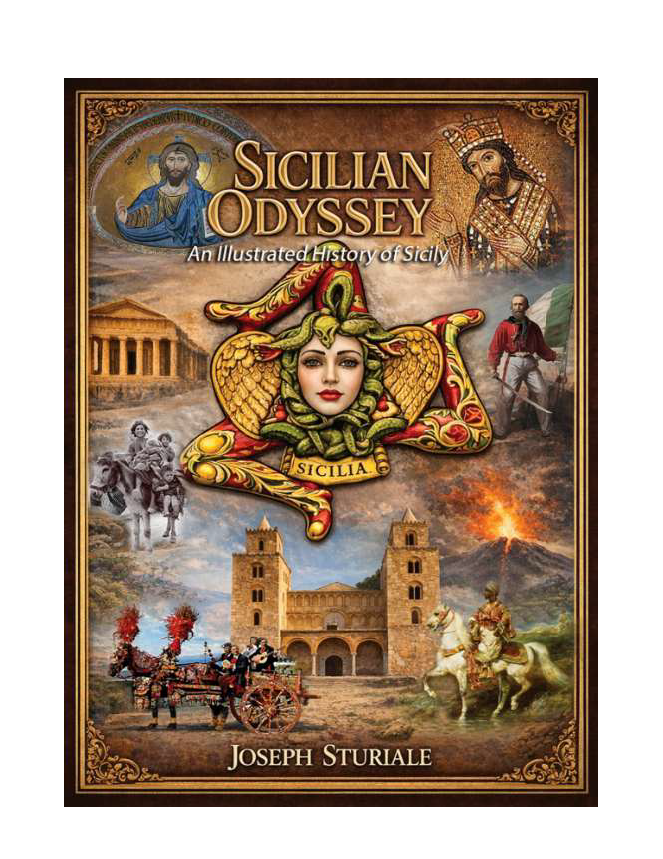
Sicily has been conquered, occupied, exploited and transformed by some of the greatest civilizations in history. Greeks, Romans, Arabs, Normans, Spaniards and others have left their indelible marks upon the Mediterranean island. Yet, amid the wars, political intrigues and changing dynasties, one story has too often been overlooked: that of the Sicilian people themselves.
Joseph Sturiale seeks to correct that omission in Sicilian Odyssey: An Illustrated History of Sicily, an ambitious and richly illustrated historical narrative spanning more than three millennia. Across 27 chapters, Sturiale recounts the extraordinary history of an island whose strategic location made it both a coveted possession and a crossroads of civilizations.
The result is an expansive work that combines historical scholarship drawn from established sources with a deeply personal appreciation of Sicilian heritage.
Sturiale was born in Santa Teresa di Riva, near Messina, and emigrated to New York with his parents in the 1960s. Growing up in America, he became increasingly troubled by the association of Sicilian identity with organized crime, particularly through Hollywood productions such as The Godfather. His own family consisted of hardworking immigrants whose lives bore little resemblance to the cinematic gangsters supposedly representative of their homeland.
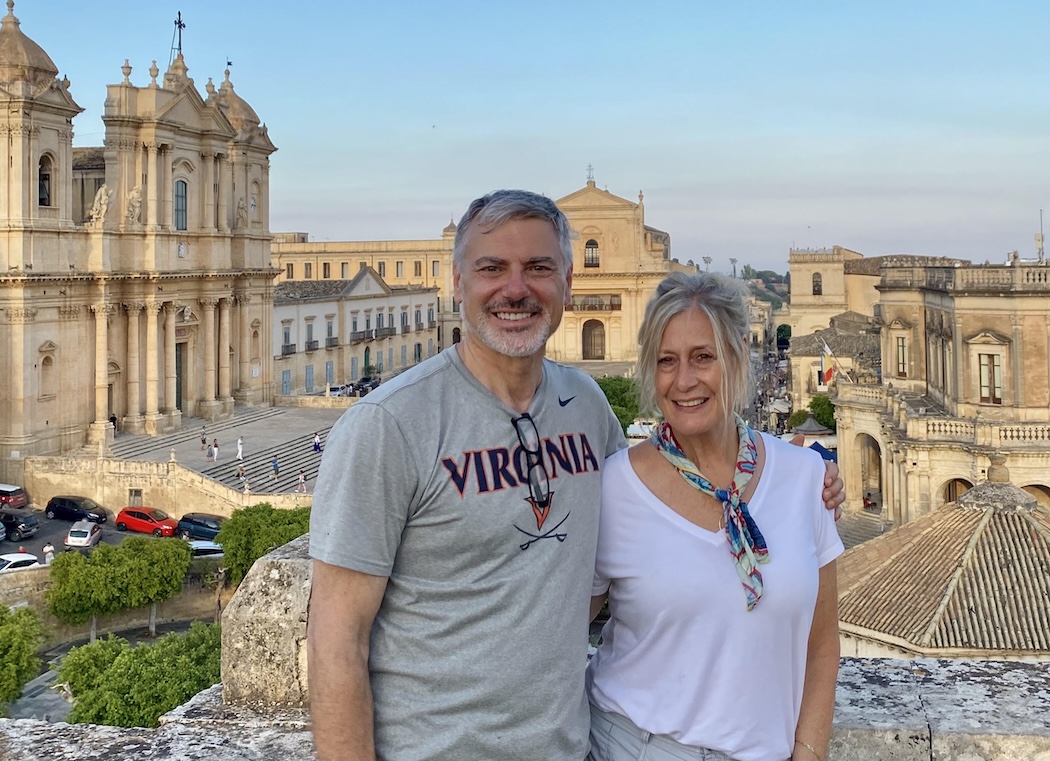
The author, Joseph Sturiale, pictured with his wife, Jean, in Noto
Determined to discover the authentic history of his ancestors, Sturiale immersed himself in historical literature, particularly the writings of British historian John Julius Norwich. What began as a personal project intended for his family eventually developed into a comprehensive history for a broader audience.
The book begins with Sicily's earliest inhabitants, the Sicani, Sicels and Elymians, before examining Greek colonization and the emergence of Syracuse as one of the ancient Mediterranean's most formidable cities. Sturiale explores the conflicts between Greeks and Carthaginians, Roman conquest, and the island's transformation under successive imperial administrations.
Particularly compelling are the chapters devoted to the Arab and Norman periods. Under Arab administration, Sicily experienced significant agricultural, commercial and cultural development. The subsequent Norman conquest produced one of medieval Europe's most remarkable kingdoms.
Sturiale describes the reign of Roger II and the splendor of Palermo's royal court, where Latin, Greek and Arab traditions contributed to an extraordinary cultural synthesis. The architectural achievements of this period, including the magnificent churches and monuments of Palermo and Monreale, remain enduring symbols of Sicily's cosmopolitan past.
The narrative subsequently turns toward the island's political decline under successive foreign dynasties. The Hohenstaufen, Angevins, Aragonese, Spanish and Bourbons figure prominently in an account marked by dynastic struggles, ecclesiastical interference, economic exploitation and popular rebellion.
Sturiale is particularly critical of papal intervention in Sicilian political affairs during the 13th century. His treatment of Frederick II and the destruction of the Hohenstaufen dynasty reveals an author willing to challenge conventional interpretations and express indignation over historical injustices.
The revolutionary movements of the 19th century and Giuseppe Garibaldi's conquest of Sicily receive considerable attention. Rather than presenting Italian unification as an uncomplicated triumph, Sturiale examines the disappointments that followed incorporation into the Kingdom of Italy. Persistent poverty, inadequate investment, political corruption and growing criminal influence complicated the promises of national unity.
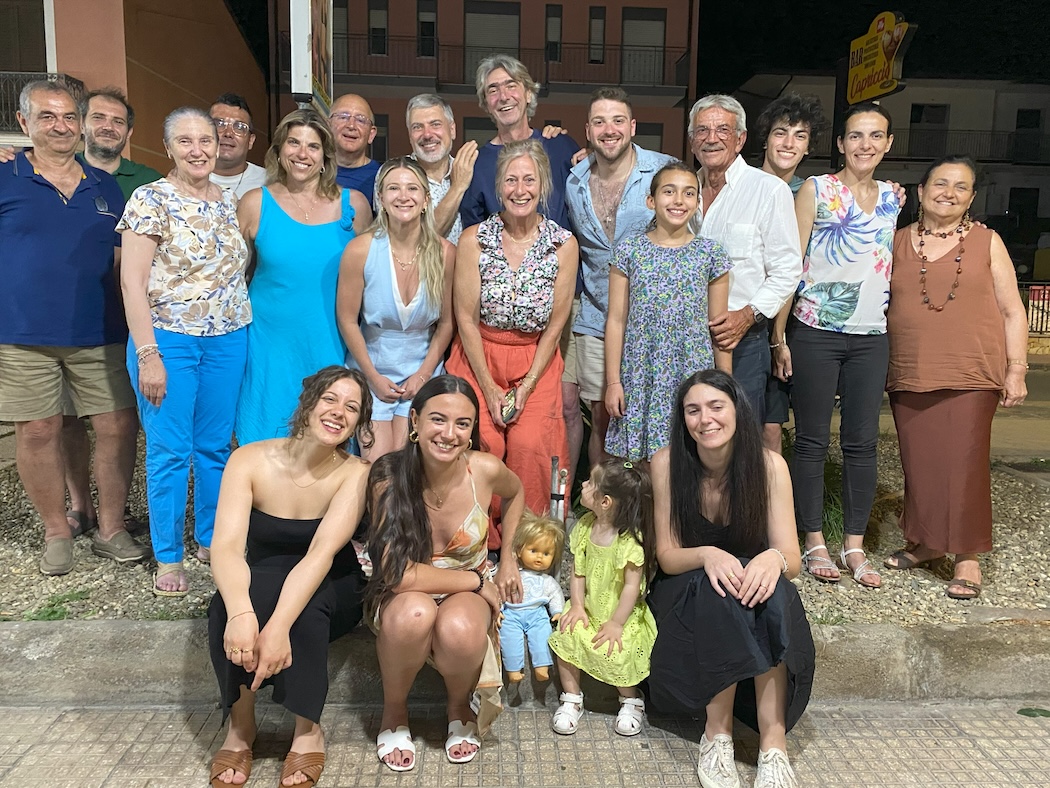
Joseph Sturiale, center last row, with wife Jean, center second row, in a family photo in Saint Alessio, Sicily, 2025
The book's later chapters examine mass emigration, fascism, the Second World War and the Mafia's expanding influence over Sicilian society.
Here the narrative reaches its emotional climax.
Sturiale recounts the courageous struggle against organized crime, particularly the sacrifices of magistrates Giovanni Falcone and Paolo Borsellino, whose assassinations in 1992 galvanized public resistance. Their story becomes central to the author's larger argument: Sicilians were not inherently defined by the Mafia but were frequently its victims and, ultimately, among its most determined opponents.
The concluding chapters describe Palermo's remarkable civic renewal while acknowledging the economic disparities and social difficulties that continue to confront Sicily.
An especially valuable feature is the book's extensive visual presentation. Historical paintings, photographs, maps, architectural illustrations and chronological charts accompany the narrative, helping readers understand the island's changing political geography and cultural development.
Sturiale writes for general readers rather than academic specialists. His prose is direct, accessible and frequently passionate. Although the absence of detailed scholarly footnotes limits the book's usefulness as a formal academic reference, its extensive bibliography and broad historical coverage provide opportunities for further exploration. At times, the author's interpretation of Sicily's past is decidedly sympathetic to its inhabitants and sharply critical of their rulers. Such judgments invite debate, but they also give the narrative its distinctive character.
Ultimately, Sicilian Odyssey is more than a chronological account of conquest and political change. It is a tribute to a people who preserved their cultural identity through centuries of upheaval.
For Sicilian Americans seeking a deeper understanding of their ancestry, and for anyone interested in Mediterranean and Italian history, Joseph Sturiale has produced a substantial and engaging introduction to one of Europe's most fascinating civilizations.
His central message is unmistakable: Sicily's greatest historical achievement is not found solely in its monuments, kingdoms or artistic treasures, but in the endurance and dignity of its people.
⸻
Editor's Note: You can learn more about the author—Joseph Sturiale—and purchase his fascinating new book at https://sicilianodyssey.com/buy-the-book/
Where to buy the book?
You can purchase Sicilian Odyssey by Joseph Sturiale at: Amazon.com and at Barnes & Noble.
⸻
Primo Interview
JOSEPH STURIALE
Author of Sicilian Odyssey
In this exclusive interview with PRIMO, Joseph Sturiale discusses his new book, Sicilian Odyssey, his exploration of Sicily's rich history, enduring traditions, and cultural heritage, and the personal journey that inspired him to celebrate the island's distinctive character and lasting influence.
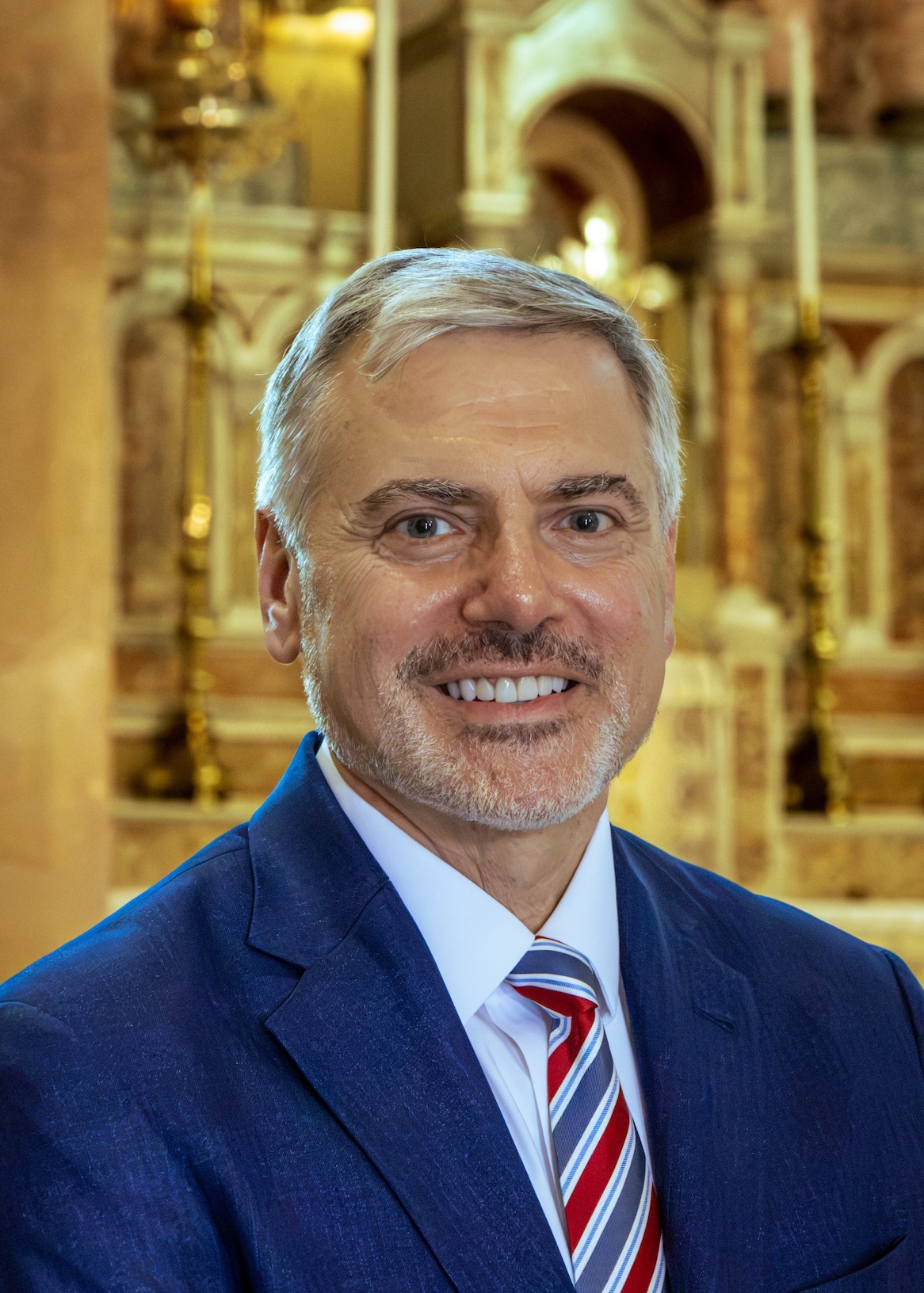
You were born in Sicily and immigrated to the United States as a young child. In your introduction, you describe how Hollywood's portrayal of Sicilians, particularly in The Godfather, conflicted with your own family's experiences. How did this disconnect influence your decision to write Sicilian Odyssey, and what misconceptions about Sicilians were you most determined to correct?
I have always been troubled by the false and unjust portrayals of Sicilians by the media and entertainment industries, as an inherently violent and immoral people, living by some perverse code of honor. While I consider the first two Godfather films to be cinematic masterpieces, the films have been harmful to the perception of Sicilians around the world. Mario Puzo's novel and Francis Coppola's films are unquestionably marvelous works of fiction with vivid, unforgettable characters, but both failed to accurately portray the lives of real-life Sicilians. Regrettably, the films' immense worldwide success and acclaim has presented a singular image of Sicilians as a crude, violent, morally corrupt people, an image now frozen in time. This false messaging has been repeatedly reinforced by hundreds of additional exploitative films and television programming, which continue to glorify the Mafia life-style. My original motivation to write the book was to leave my three daughters (and their future children) a realistic account of the history and heritage of their Sicilian ancestors, one that they could be proud of.
Sicily has experienced more than 2,000 years of foreign conquest and domination. Yet, as your book illustrates, certain periods, particularly under the Arabs and Normans, brought extraordinary cultural and economic achievements. Which period of Sicilian history do you consider its greatest age, and what lessons can modern Sicily draw from that era?
I'm most interested in the periods of the Arab and Norman rule of Sicily, between the 9th-12th centuries, which represented the glory days of Sicilian art, culture, and economic achievement. Most foreign conquerors came to Sicily to exploit the agricultural and mineral riches of the land, extracting the vast wealth of the island without regard for the welfare of the Sicilian people. However, Arab and Norman rulers successfully forged a distinct Sicilian identity from the disparate nationalities and faiths. Both of these ruling dynasties recognized that the peace and prosperity of the island was maximized when all ethnicities and faiths of the kingdom were respected and protected. The successful multi-cultural mix of Greek and Latin Christianity, Islam, and Judaism has left behind some of Europe's most magnificent religious, historical, and cultural monuments. In Sicily the Norman rulers demonstrated that, by utilizing good and just leadership, a nation's diverse ethnic and religious differences can be a source of great strength rather than weakness.
One of the more provocative aspects of your book is your criticism of the medieval papacy, particularly its role in the destruction of the Hohenstaufen dynasty. Why do you believe this episode deserves greater attention, and how might Sicily's history have unfolded differently had Frederick II's dynasty survived?
In the mid-13th century a series of greedy and worldly popes launched what amounted to a Vatican financed crusade to destroy the rightful, independent Sicilian kingdom on their southern border and steal its fabled riches. The regime change plot unfolded over three decades, but ultimately succeeded in 1266, resulting in more than seven successive centuries of poverty, misery, and political repression and upheaval for the Sicilian people. I often wonder what might have been the fate of Sicilians if their once glorious kingdom had survived. How much human misery of our ancestors may have been avoided and what level of greatness might have the Sicilian nation achieved ? I suspect that if the independent Sicilian Kingdom had survived, the European renaissance might have occurred sooner and would have originated in the southern regions of Italy rather than the North. The unification of Italy might have also occurred sooner and would likely have resulted in greater economic parity across the entire nation.
Your account of Giuseppe Garibaldi's conquest of Sicily and the subsequent unification of Italy challenges the conventional narrative of the Risorgimento as an unequivocal national triumph. In your assessment, did Italian unification ultimately benefit Sicily, or did it perpetuate many of the political and economic injustices that Sicilians had endured under foreign rule?
We all know that history is always written by the victors, who will seek to glorify their triumphs and bury their mistakes and crimes. There can be no debate that after the Risorgimento in the early 1860s, the new Kingdom of Italy forced northern Italian laws, customs and norms upon Sicily and the other southern regions without consultation or consideration. Often Sicily was governed by Rome at the point of a bayonet by hostile Northern Italian armies of occupation. It is also well documented that the new Italian regime initiated a host of new taxes and economic policies which adversely impacted the already impoverished populations in Sicily and the South, triggering decades of mass migration to the Americas in order to avoid starvation.
Historians may debate the necessity of such political actions and policies for the benefit of the new Italian nation. However, these policies proved disastrous to the Sicilians people, perpetuating and worsening their endless cycle of poverty, repression, and hopelessness. As a result, the new Italian government in Rome was viewed by many Sicilians as yet another foreign occupation. I believe that Sicily was always destined to be a part of a unified Italian nation. However, the vast economic disparities today between the regions of the North and the South are a direct legacy of these failed, and often discriminatory, political and economic policies enacted more than 160 years ago by the early unified Kingdom of Italy.
The struggle against the Mafia occupies an important place in the concluding chapters of Sicilian Odyssey. You give particular attention to Giovanni Falcone and Paolo Borsellino, whose sacrifices helped transform Sicilian society. Do you believe their legacy represents a fundamental turning point in Sicilian history, and how has the island's relationship with organized crime changed since their deaths?
Without question I believe that the assassinations of judges Falcone and Borsellino marked a clear historical turning point in the lives of Sicilians, and for the Region of Sicily. The brutal murders of these Anti-Mafia champions, triggered furious demonstrations in Sicily against the Mafia and their political allies in Rome. Sensing the start of an unstoppable people's revolution, which threatened the political order in Rome, the Italian government was forced to commit all the resources of the state to take down the Sicilian Mafia. The modern day Mafia in Sicily has been so degraded by decades of successful Italian law enforcement efforts that it bears scant resemblance to the former all-powerful criminal organization of the late 20th century. As a direct result of the defeat of the Sicilian Mafia in the early 21st century, modern Sicily is now one of the safest regions in Europe, and is currently experiencing a massive cultural revival, making it one of the hottest new tourist destinations in Italy.
You originally intended Sicilian Odyssey as a historical account for your own family before deciding to share it with a wider audience. After researching and writing this extensive history, what surprised you most about your ancestral homeland? More importantly, what single message would you like younger generations of Sicilian Americans to take away from your book?
What most surprised me was learning that young Sicilian students in Sicily today are not taught Sicilian history in the public schools. This means that the understanding of true Sicilian history remains elusive, even among most native Sicilians. This made it even more important to me that my children understood that they were the product of a proud, yet often tragic, cultural heritage. In the absence of the truth, Hollywood's slanderous depictions of Sicilians as violent, criminal thugs becomes the accepted worldwide view. I concede that my one book cannot possibly roll back decades of false worldwide perceptions perpetuated by a multi-billion dollar entertainment industry. However, I wanted my children, and other young Sicilian descendants, to have at least one true source to provide an accurate depiction of their cultural history and heritage.
Editor’s Note: You can purchase Sicilian Odyssey by Joseph Sturiale at: Amazon.com and at Barnes & Noble
Joseph Sturiale plans to publish Sicilian Odyssey in the Italian language. You can find out the latest news about the author and purchase Sicilian Odyssey by visiting the author's web site: https://sicilianodyssey.com/
___________________________________________________________________________________________________________________________________________________

____________________________________________________________________________________________________________________________________________________
Please visit our Books' page to review our latest inventory of books on all things Italian: cookbooks, history, art and culture.