.svg.png)
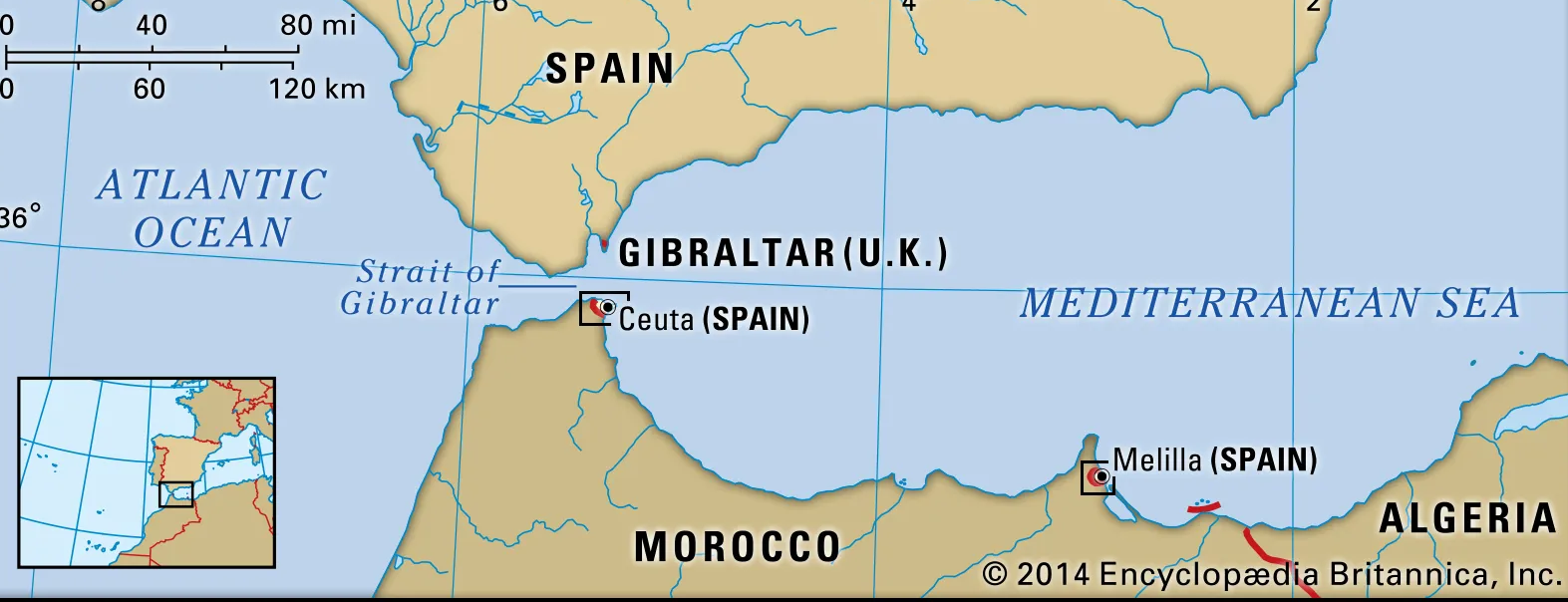
A portion of Spain lies on the continent of Africa, sharing a border with Morocco, where the recent mass migrant rush happened
Spagnoli, vietato l’ingresso!
The sudden influx of some 72,000 Moroccan migrants into the Spanish enclave of Ceuta has sparked an escalating dispute between Italy and Spain.
Italy has temporarily reimposed border controls on arrivals from Spain following one of the largest and most unusual mass migration events Europe has witnessed in recent years.
Italy’s Prime Minister Giorgia Meloni announced that selective checks will be conducted on non-European Union nationals arriving from Spain by air and sea. Italy has also coordinated with France to strengthen controls along the French-Italian frontier.
The action amounts to a partial suspension of the normally border-free travel guaranteed under Europe's Schengen system. Rome says the controls are temporary and necessary to prevent migrants who recently entered Spanish territory from moving onward through Europe.
Prime Minister of Spain, Pedro Sánchez, says Italy's measures are unjustified and discriminatory. He has given Rome until Sunday, August 9, to remove them. Otherwise, Sánchez says he will impose reciprocal measures against arrivals from Italy.
A portion of Spain lies on the continent of Africa, sharing a border with Morocco, where the recent mass migrant rush happened
______
A Moroccan Invasion
Behind this intense quarrel between two major European Union countries is an unusual event.
Some 72,000 migrants from Morocco rushed into Ceuta, Spain's small enclave on the North African coast. Ceuta is Spanish and therefore part of the European Union, but geographically it sits in Africa, bordered by Morocco and the Mediterranean Sea.
The number is staggering. To put 70,000 people into perspective, that is roughly equivalent in manpower—to several full-sized army divisions.
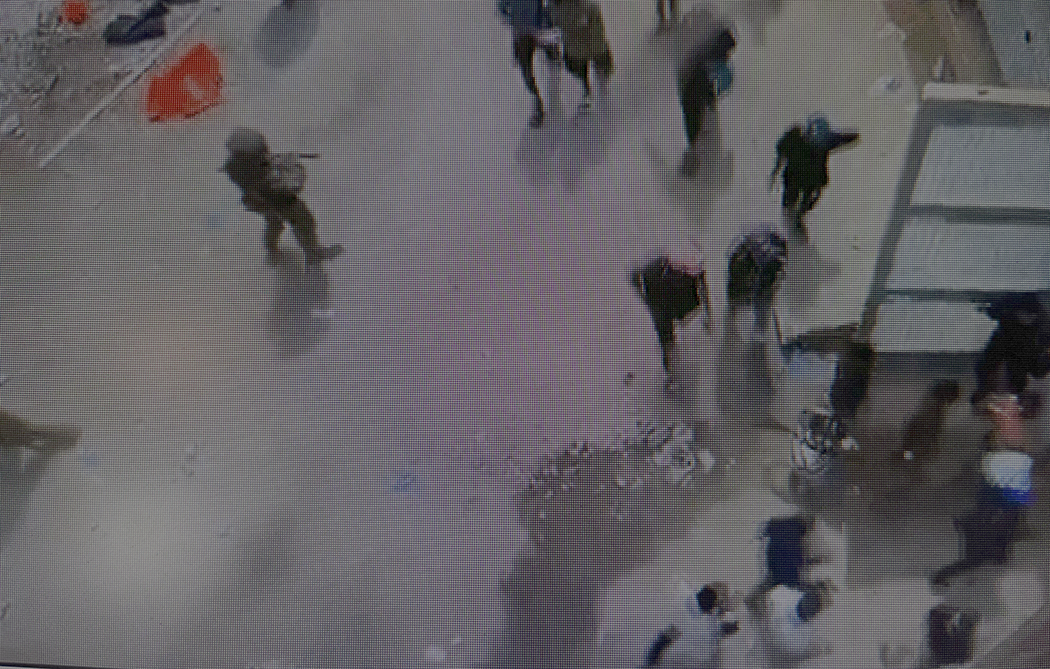
A rough video shot from surveillance camera footage shows a rounding up of illegal migrants by Spanish authorities in Ceuta
⸻
Not Without Warning
Ceuta was already experiencing a migration emergency. More than 1,000 people had entered the enclave by swimming from Morocco during a single week. By July 29, more than 1,500 had made the crossing, and Ceuta's president, Juan Jesús Vivas, warned that the city's migrant facilities were approaching collapse.
Days later, tens of thousands came toward Ceuta, overwhelming Spanish authorities. Spain deployed military units to reinforce police. Some migrants entered by land while enormous numbers attempted to reach Spanish territory through the water. At least 80 people died during the crisis.
Spain did not locate and arrest tens of thousands of migrants scattered throughout the country and then deport them. Ceuta's unusual geography effectively contained much of the influx. The enclave covers only about seven square miles, and migrants who could not proceed to mainland Spain found themselves with few options.
Spanish authorities say the overwhelming majority of migrants returned to Morocco. Some 1,000 unaccompanied minors remain and must be handled under separate legal protections. Spain contends that migrants in Ceuta cannot simply enter the Schengen zone and travel freely across Europe.
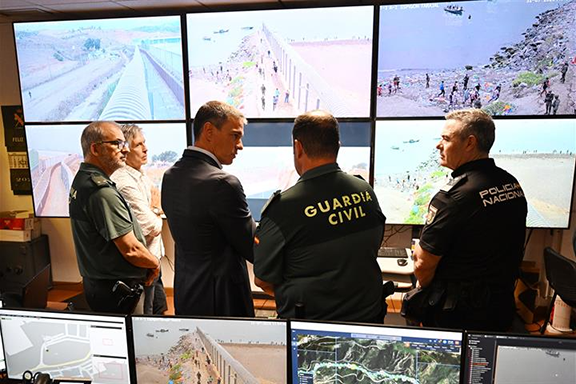
The Spanish prime minister monitors the migrant rush from a control room, August 2, 2026.
Attribution:https://www.lamoncloa.gob.es/presidente/actividades/Paginas/2026/310726-sanchez-reunion-ooordinacion-ce
______
How Could This Happen?
The answer lies with social media. Various sites mobilized people toward Ceuta. Rumors circulated on social media regarding a July ruling by Spain's Supreme Court restricting immediate returns of migrants who enter Ceuta by swimming. Some interpreted the ruling as creating an opportunity to reach and remain in Spanish territory.
Meloni argues that Italy has a right to protect itself against possible secondary migration. Sánchez insists there is no factual justification for Italy's action and is threatening retaliation.
Thus, an extraordinary rush of people from Africa into a seven-square-mile piece of Spain has accomplished something few might have expected: it has placed two major Mediterranean countries on opposite sides of a growing dispute over Europe's borders and the future of free movement within them.
.png)
Prime Minister Pedro Sánchez welcomes Italy's Prime Minister Giorgia Meloni to Spain in April, 2023, attribution: https://www.lamoncloa.gob.es/multimedia/galeriasfotograficas/presidente/Paginas/202
_____
Editor's Note:
The website for the Spanish government—https://www.lamoncloa.gob.es/lang/en/paginas/index.aspx
READ HERE THE NEW EDITION - FIRST 2026 PRIMO
—————————————————————————————————————————————————————————————————————————————
Please visit our DVDs Page to shop our latest collection of DVDs on all things Italian: Films from Italy's Golden Age, Documentaries on Italian American life, ancient Rome, and religion.


Please visit our Books' page to review our latest inventory of books on all things Italian: cookbooks, history, art and culture.

Other articles to read...