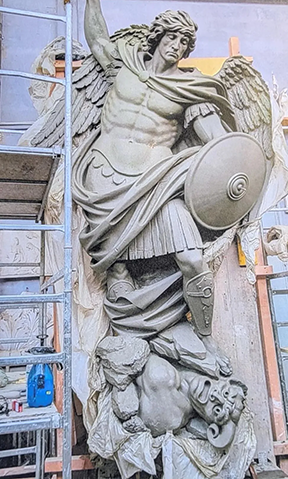
Statue of St. Michael to be installed in Quincy
They’re worse than the Devil.
St. Michael the Archangel could beat Satan—but not, thus far, the Woke Cancel culture of Quincy, Massachusetts.
He—along with St. Florian—are to be featured as two monumental bronze statues commissioned by Quincy for that city’s new public safety headquarters. But a few people don’t want them there.
Statue of St. Michael to be installed in Quincy
______
Divine Protectors
St. Michael is the patron saint of police officers while St. Florian, the fourth-century Christian martyr, is regarded as the patron saint of firefighters.
Standing approximately 10 feet tall, each statue was created by Sergey Eylanbekov, a Russian-born sculptor based in Italy who had previously produced public monuments for Quincy. Together the monuments cost the city approximately $850,000.
Mayor Thomas Koch, a practicing Catholic, conceived the project as part of the artwork for the city’s new public safety headquarters. The connection was readily apparent: Florian for the firefighters and Michael for the police.
As in other renditions, St. Michael is depicted as winged and armored, overcoming a demon beneath him. Florian is shown pouring water onto a burning building. They are symbols of courage and public service. Yet, their opponents see them as figures of violence and as an unconstitutional government endorsement of religion.
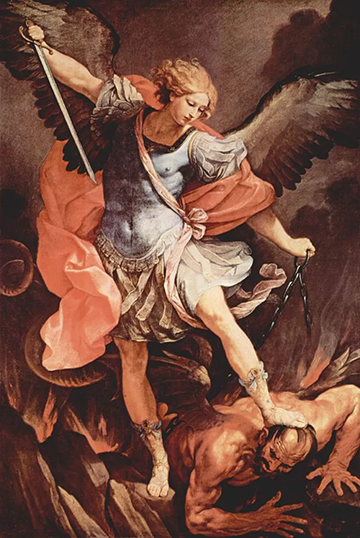
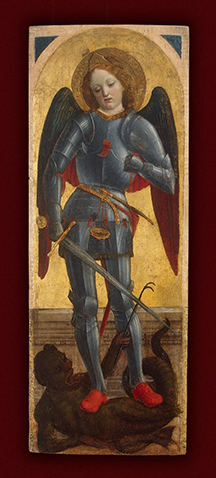
Paintings of St. Michael as rendered in the Renaissance by Guido Reni and Vincenzo Foppa
⸻
Devilish Plantiffs
Last year, a group of Quincy residents began the current lawsuit against the city and Mayor Koch. They’re represented by the American Civil Liberties Union, Americans United for Separation of Church and State and the Freedom From Religion Foundation. They contend the placing of two figures prominently on a municipal government building gives Christianity—and particularly Catholic religious imagery—a preferred position in the public square.
They claim Koch’s plans for the statues were not properly presented to the City Council. They say that a petition opposing the project gathered more than 1,600 signatures.
A Massachusetts Superior Court judge issued a preliminary injunction preventing installation of the statues. The dispute then reached the Massachusetts Supreme Judicial Court on May 6, 2026. The case centers principally on Article 3 of the Massachusetts Declaration of Rights and its requirement of governmental neutrality toward religion.
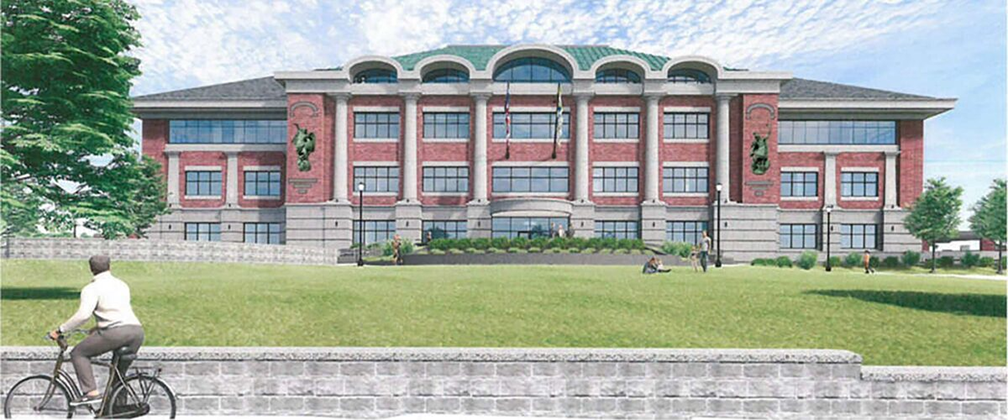
An artist rendering of where the statues are to be placed at the municipal building in Quincy, Massachusetts
______
Angelic Defense
Attorneys representing the city belong to an organization—Becket Fund for Religious Liberty. They contend that the religious origins of Saints Michael and Florian do not erase their secular and civic meanings. “Across the country, police and fire departments have long used the figures of Michael the Archangel and Florian,” they say.
Quincy Police Chief Mark Kennedy recalled receiving a St. Michael medal from his parents upon graduating from the police academy. The archangel has become a symbol to transcend religion for police officers—representing good triumphing over evil.
Is St. Michael being displayed because Quincy wants citizens to believe in an archangel? Or because an ancient religious figure has evolved into a cultural symbol of protection, courage and sacrifice?
St. Michael predates the Catholic Church as an institution. He appears by name in the Book of Daniel and later in the New Testament in the Book of Revelation. He is venerated by Catholics and Orthodox Christians and recognized throughout much of Protestant Christianity. The archangel Michael also has a place in Jewish and Islamic traditions.
The image chosen for Quincy recalls the Book of Revelation when Michael and his angels battle the dragon identified as Satan. He stands as the warrior against evil—why generations of soldiers and police officers have adopted him as their protector.
The Massachusetts justices appeared to recognize the difficulty. During oral arguments, they pressed the city about the unusual manner in which the project had been undertaken, but also questioned whether prohibiting the statues could conflict with more recent U.S. Supreme Court treatment of religious expression and historical religious monuments.
If an image originated in religion, must it forever remain exclusively religious? That is the question at the heart of this current controversy.
.jpg)
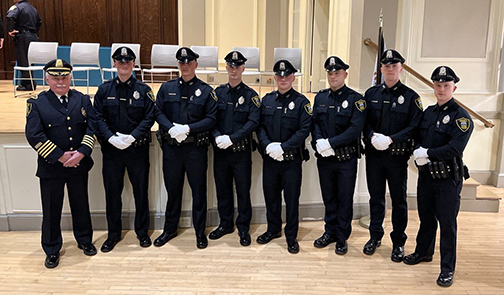
Mayor Thomas Koch and a group of new police recruits
in Quincy, Massachusetts
_____
Editor's Note:
To learn more about the Becket Fund, please log on to: https://becketfund.org
READ HERE THE NEW EDITION - FIRST 2026 PRIMO
—————————————————————————————————————————————————————————————————————————————
Please visit our DVDs Page to shop our latest collection of DVDs on all things Italian: Films from Italy's Golden Age, Documentaries on Italian American life, ancient Rome, and religion.
Please visit our Books' page to review our latest inventory of books on all things Italian: cookbooks, history, art and culture.
Other articles to read...