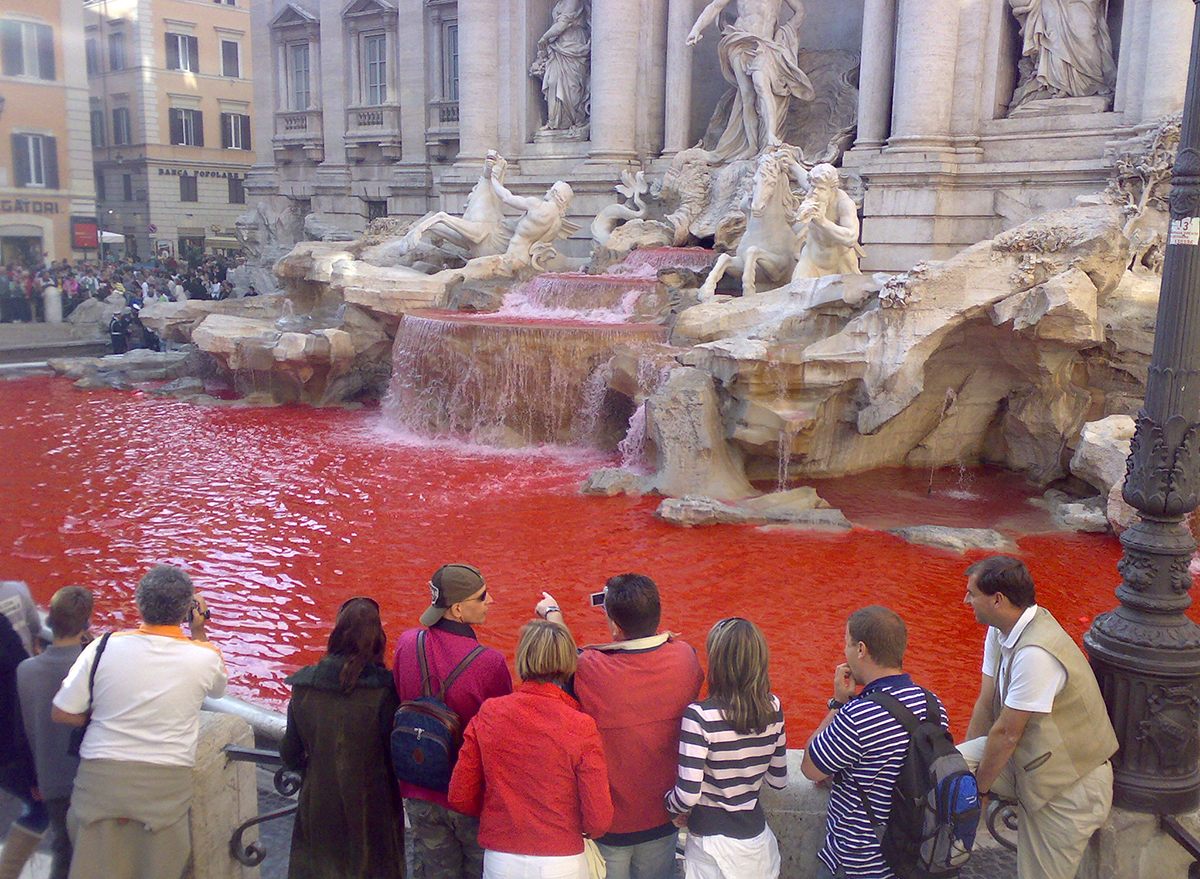
Flowing red: Food dye degrades the Trevi Fountain in 2007 and 2017
Save those coins...
The ones you planned to throw into the Trevi Fountain. You’ll need them to buy the ticket to see it.
Two Euros—that’s the price tag Rome has now made for visitors to get close to the Trevi Fountain.
Rome has had enough—Over the last 20 years—The Trevi Fountain has been disrespected, cheapened, defiled. Too many visitors. Too large were the crowds. Too many acts of vanity and vandalism.
Partitions are now be in place. A ticket counter is up and running. Staff are on hand alongside security. You can’t get in without a ticket. After you pay an entrance fee, you will get just enough time to ponder the artwork, throw a coin or two into the fountain pool, take a few photos, and then move on. Get going. Go on your way. Give others a turn.
Flowing red: Food dye degrades the Trevi Fountain in 2007 and 2017
The pool of the Trevi Fountain can no longer be a place where 20-somethings can trespass and trounce the tepid waters reminiscent of the film, La Dolce Vita. The city wants to put a stop to any and all people who use the Trevi as clickbait or, worse, and more destructive, as a symbol of social protest.
Acts of vandalism and defilement increased over the last two decades. The Trevi became victimized when in:
1. October 19, 2007 – Italian activist Graziano Cecchini poured red dye into the Trevi Fountain, turning the water red. This was widely reported as an act of vandalism/protest.
2. October 26, 2017 – Cecchini repeated the stunt, again coloring the water red.
3. May 21, 2023 – Climate activists from the group Ultima Generazione dumped charcoal into the fountain, turning the water black as part of a protest related to climate change.
4. June 2024 – A tourist climbed over protective barriers and onto the fountain — an act that is widely described as vandalism or disrespectful intrusion (though not permanent damage).
5. Multiple tourist rule-breaking incidents (ongoing, reported through at least 2025) – People have jumped into the fountain, climbed on it, or otherwise violated protections. People jumped into the pool at night. These are usually treated as misdemeanors or enforcement actions (fines, bans) rather than long-lasting damage, but they are frequent enough to be mentioned in media about the monument.
⸻
Blame Fellini?
The legacy of Federico Fellini lived on far past his passing on October 31, 1993. His masterpiece La Dolce Vita haunted the Trevi Fountain after his death.
La Dolce Vita premiered in 1960. The film gave the world an image of rebellion. The baroque inspired Trevi Fountain was trespassed in the film’s most famous scene.
Sylvia, a Swedish-American actress, played Anita Ekberg, wanders about Rome in La Dolce Vita. She is accompanied by reporter, Marcello Rubini, played by Marcello Mastroianni. At the Trevi Fountain, late at night, she wades into the pool in her black dress as if she were a siren. She calls out to Marcello to join her—"Marcello, come here!" There in the dead of night, dressed in their evening ware, they embrace, waist high in cold water, stepping on coins thrown in the fountain.
Fellini saw the landmark as the perfect backdrop to convey the moral decadence of modernity. Designed by Nicola Salvi in 1730, completed in 1762 after he died, the Trevi Fountain was a masterpiece of stone and water. The scene with Ekberg and Mastroianni broke down the barrier between the old and new. The scene was misinterpreted. The message was unintended—Live for today—Take license to traverse, to mock, to damage the great landmarks of old.

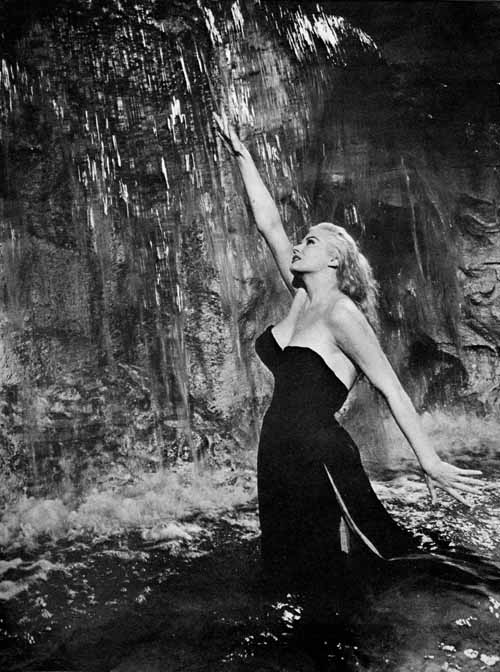
Federico Fellini's masterpiece "La Dolce Vita" starred Anita Ekberg
_____
Last One In...
Almost from the time after the release of La Dolce Vita, adventurous visitors to the Eternal City slipped into the fountain at night, just like Sylvia and Marcello. Some were fined, chased off, and scolded. Others got away with it. They jumped into the Trevi as a gesture from a film to give notice to decadence, fame, and moral drift.
Fast-forward to the 2010s and 2020s. The fountain filled with a different kind of nocturnal swimmer: 20-somethings with phones raised, friends filming, laughter aimed outward toward an invisible audience.
Excess fed an algorithm. Beauty was assaulted. Any excuse led to the defilement of the Trevi Fountain, be it for climate change, be it for anything.
.png)
Triton grappling with a sea horse—one of many sculpted renderings in the Trevi Fountain
⸻
Crackdown Commences
Roman authorities aren’t reacting to nostalgia. They’re reacting to repetition without meaning. When a symbolic act loses its memory, it becomes mere disruption—a costly contagion.
Rome has learned that once myth detaches from memory, it no longer educates—it multiplies.
The Trevi Fountain still flows. Coins still arc through the air. Wishes are still made.
Yet, the image that once whispered vita dolce—sweet life, bitter truth—now shouts look at me, look at my cause.
The Trevi Fountain deserved better. Much better. If people now have to pay to see it—so be it.
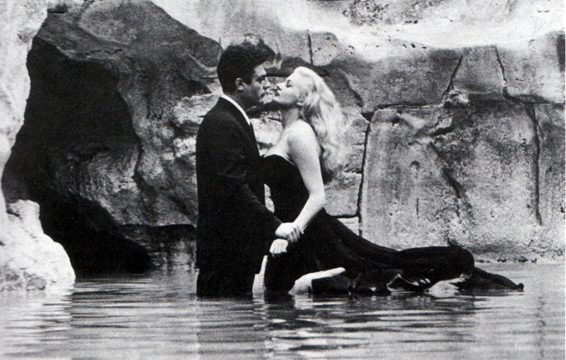
"Marcello, come here!"—The famous scene from "La Dolce Vita"
_____________________
Trevi Fountain introduces €2 tickets amid record crowds and controversy
Rome has moved to curb the excess of visitors to the Trevi Fountain. The city has put in place a new fee for tourists. You won’t be able to see the Trevi Fountain as you once did. Now you will have to pay—two Euros.
For centuries, the Trevi Fountain belonged not just to Rome, but to the world — a theatrical burst of marble and water that required no ticket, no reservation, no explanation. Those days are gone.
Rome’s new €2 fee for visitors is meant to reduce the number of people who can see this masterpiece of stone and water up close.
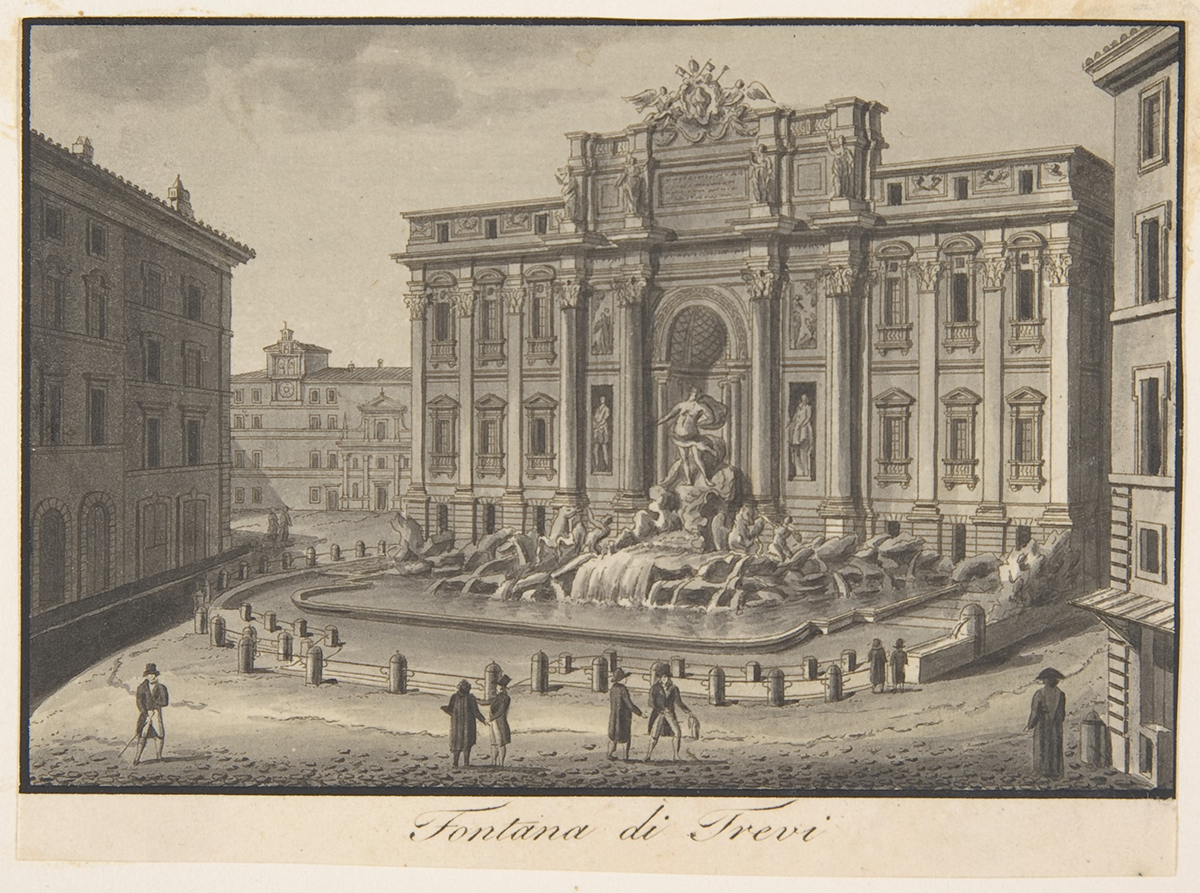
From a print in the 1800s, we see the scarcity of people compared to today at the Trevi
What Is (and Is Not) Being Charged
First, a crucial clarification—No one will be charged simply to see the Trevi Fountain.
The fountain will remain fully visible — day and night — from the surrounding Piazza di Trevi, just as it always has. The €2 fee applies only to those who wish to enter the immediate basin in front of the fountain, where visitors traditionally crowded together to take photos and toss coins into the water.
In other words, the new fee is not a ticket to the monument, but a fee for close-proximity access.
Barriers, Not Turnstiles
Rome is not enclosing the piazza or building permanent structures. Instead, officials will create a clearly defined inner zone. Temporary barriers or low partitions will be put in place. Security will stand beside staff at managed entry points. Clearly marked access lanes will move people to and fro the viewing area.
Rome is not implementing a museum entrance, but a crowd control system. You step into the zone, linger briefly, then exit — allowing the next group to enter.
Is There a Time Limit?
As of now, there is no fixed time limit attached to the €2 ticket.
You are not given 15 minutes, 30 minutes, or a timed slot. Instead, time is regulated indirectly through capacity limits (previously capped around 400 people in the inner area).
In practice, visitors can expect a few minutes of close-up viewing, enough for photos and the coin toss ritual — but not prolonged loitering.
Who Pays — and Who Doesn’t
The fee is aimed primarily at non-resident tourists. Exemptions are expected for Rome’s residents, children, and the disabled.
This mirrors policies already in place at other major Italian sites, including the Pantheon.
The Trevi Fountain now attracts tens of thousands of visitors per day, far beyond what the site was ever designed to handle. Not just emulators of La Dolce Vita, but vandals frequented the Trevi Fountain. One year, climate change activists put red dye in the water to make the Trevi resemble a conduit of blood. To prevent such unseemly acts to degrade the landmark in the future, the city saw the need for preventive measures.
Editor's Note: The web site for the Trevi Fountain is https://www.turismoroma.it/it/luoghi/fontana-di-trevi
—————————————————————————————————————————————————————————————————————————————
Please visit our DVDs Page to shop our latest collection of DVDs on all things Italian: Films from Italy's Golden Age, Documentaries on Italian American life, ancient Rome, and religion.

Please visit our Books' page to review our latest inventory of books on all things Italian: cookbooks, history, art and culture.


Other articles to read...