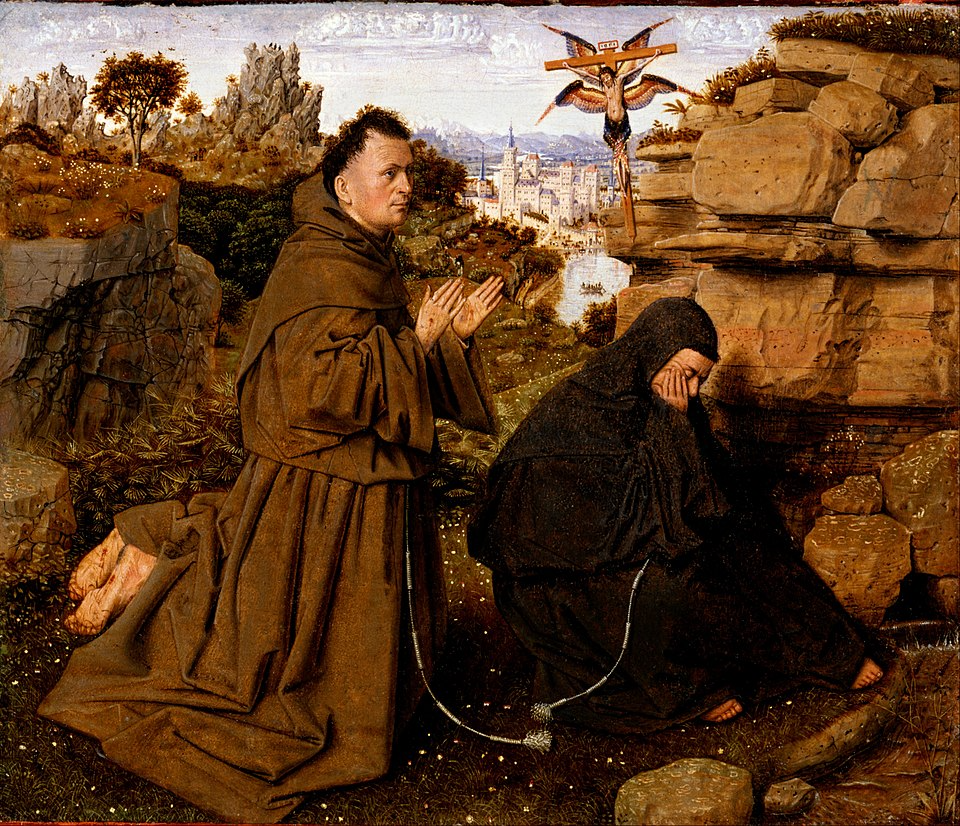
“Saint Francis Receiving the Stigmata” by Jan van Eyck, 1432
Who’s the artist?
Not Jan van Eyck—that’s for sure, says artificial intelligence (AI).
The Flemish painter, known for his oil masterpieces, likely farmed out two copies of, arguably, his most famous creation—Saint Francis Receiving the Stigmata.
Art Recognition, a Swiss firm that authenticates great artworks, made the announcement yesterday, after the analysis of Van Eyck’s works were completed by their AI system.
“Saint Francis Receiving the Stigmata” by Jan van Eyck, 1432
⸻
Two for One
Two copies of the painting exist: Saint Francis kneeling in a rocky landscape when he receives the wounds of Christ—have long been attributed to Jan van Eyck. One resides in the Galleria Sabauda, in the city of Turin; the other hangs in the Philadelphia Museum of Art.
In the 15th century, the idea of a single, unique artwork was far less rigid than it is today. Renaissance masters operated workshops. Their most popular compositions could be repeated for different patrons. The original painting was often copied by assistants; often more than two versions could be made.
Van Eyck was the court painter to Philip the Good, Duke of Burgundy. He was among the most celebrated of artists of his time. His luminous oil technique, microscopic detail, and mastery of light were revolutionary. The subject of Saint Francis receiving the stigmata resonated among the Catholic aristocracy of Europe. More than one version of this painting was probably commissioned.
The Turin and Philadelphia panels are similar but not identical. Turin’s is smaller. Subtle differences in landscape detail and figure modeling have long fueled debate. Are they both autograph works? Is one a studio replica? Or is one an imitation?
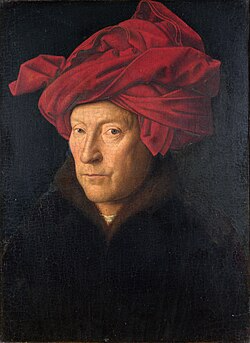
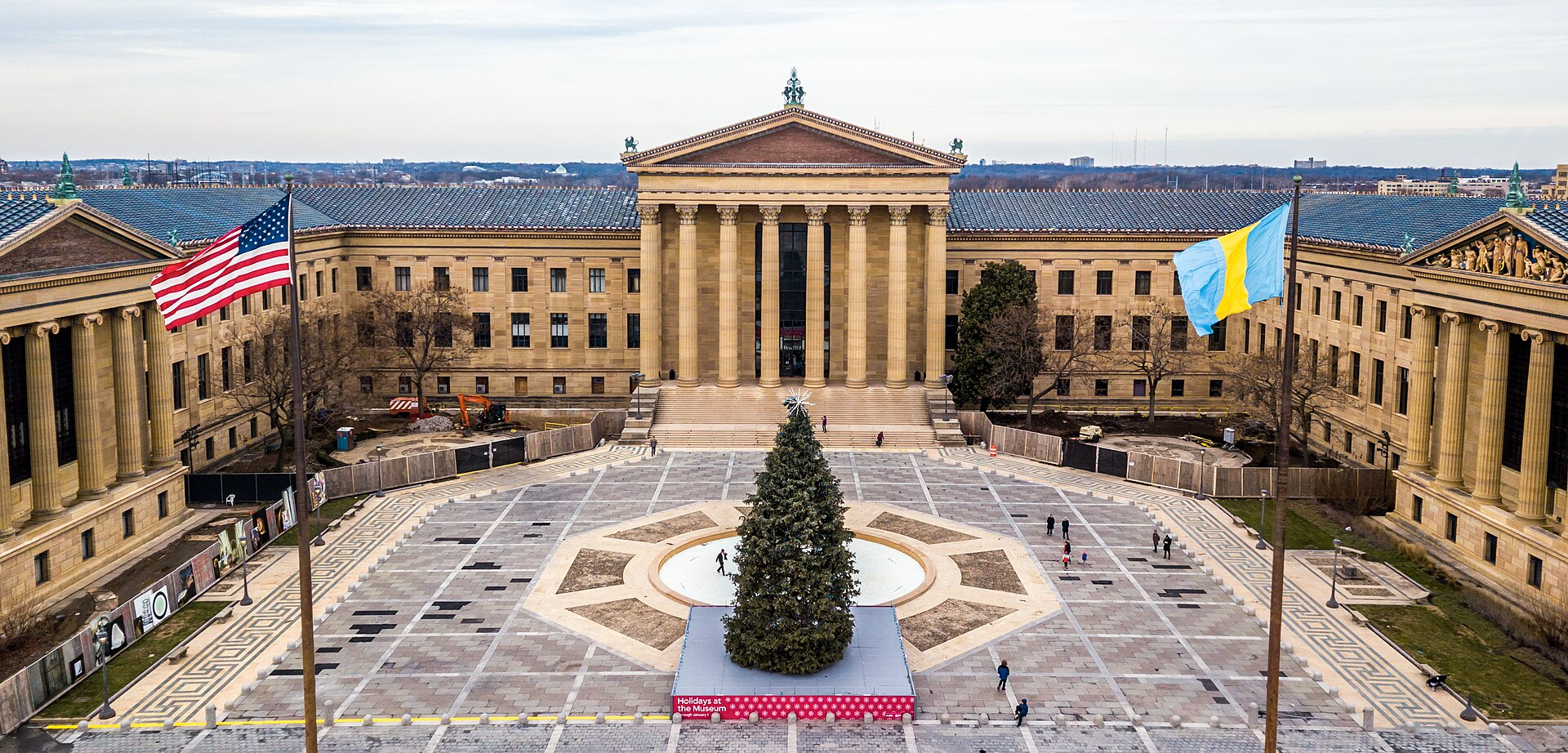
Jan van Eyck self portrait; Philadelphia Museum of Art
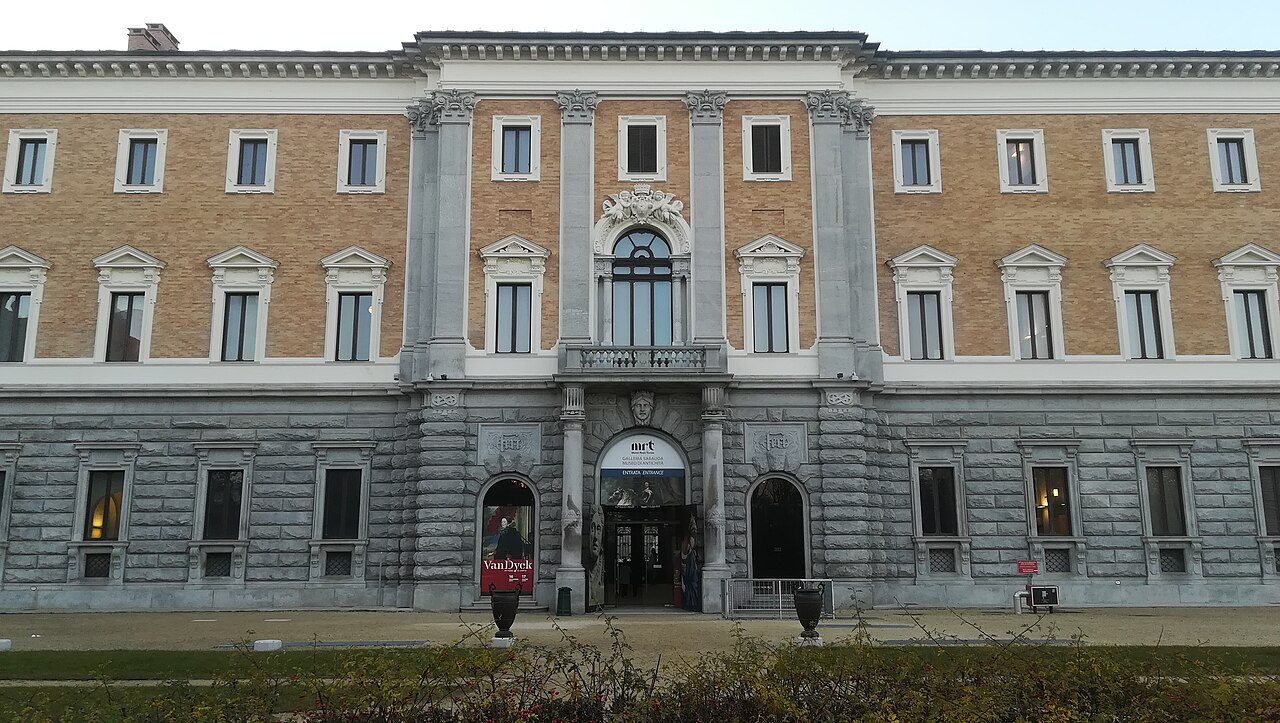
Galleria Sabauda, Turin
_____
The Artist Behind the Debate
Born in the Netherlands in 1390, Jan van Eyck was considered one of Europe’s best artists during much of his time, until his death in 1441. Although often credited—somewhat mythically—with inventing oil painting, he more accurately perfected and refined the technique. His works are celebrated for their extraordinary surface realism and psychological depth.
Van Eyck elevated Northern European art to a level of technical brilliance that influenced generations—including Italian painters such as Antonello da Messina.
Although a celebrated artist, Van Eyck was not as prolific as one might expect. He is credited with only 20 paintings. The limited amount of work by the artist played a significant role in analysis by AI.
⸻
Enter Art Recognition
Art Recognition was started in Zurich, Switzerland by Dr. Carina Popovici in 2019. A principal of the company today, Dr. Popovici leads a team of software engineers and art historians. She made headlines after Art Recognition identified counterfeit paintings, originally credited to French Impressionists Claude Monet and Pierre-August Renoir. She and her staff authenticated works by Caravaggio and Raphael, among other great artists from Italy.
The AI process by Art Recognition depends on a two-pronged system consisting of convolutional neural network and a vision transformer with shifted windows.
For Van Eyck’s Saint Francis Receiving the Stigmata, Dr. Popovici and her team began with high resolution scans of both artworks - in Turin and Philadelphia. The paintings were dissected by computer to render hundreds of thousands of small sections. Each piece was analyzed by AI in the way of brushstrokes, curvatures, pressure patterns, texture frequencies, and edge sharpness. These features were then compared to a dataset of confirmed Van Eyck works.
The system—typically a deep-learning image classifier—was able to produce a probability score. In this case, both paintings reportedly returned high “negative” probabilities—over 90%—meaning the brushstroke patterns did not statistically align with the trained Van Eyck profile.
In other words, Van Eyck didn’t paint them.


Founder and principal of Art Recognition, Dr. Carina Popovici and AI Developer at Art Recognition, Marco Latella
______
What Is Genius?
No doubt, artificial intelligence is a supreme investigator. No biases. No emotional diversions. No lack of discipline.
AI detects microscopic patterns invisible to the human eye. The advance software can uncover mechanical repetition in art forgeries.
Renaissance art, however, presents unique challenges.
The training sets from this era are limited. Van Eyck’s authenticated works are few. Deep learning systems perform best with massive datasets. Van Eyck’s 20 paintings are not enough in number for the best analysis by AI.
Van Eyck might have begun the work but allowed his assistants to finish. However, AI only measures the dominant brushstroke hand—not authorship of conception.
Artists change over time. Trained on mid-career works might lead AI to misclassify early or late pieces. AI does not consider other factors such as archival documents, patron records, and iconographic intent when deciding the artist behind the work.
AI analyzes texture, not history.
If the panels were largely executed by a workshop assistant under Van Eyck’s supervision, does that diminish their value? Or does it reflect the authentic reality of Renaissance production?
In an age where AI now judges authorship, we are forced to ask—Is genius in the hand? Or in the vision?
Saint Francis kneels in both Turin and Philadelphia, bathed in divine light, the wounds of Christ appear before him. Whether painted entirely by Van Eyck or by a trusted assistant, the spiritual intensity remains intact.
Artificial intelligence may read the brushstroke. Yet, the mystery of creation still belongs, at least partly, to human history.
Editor’s Note: The web site for Art Recognition is https://art-recognition.com
The web site for the Philadelphia Museum of Art is: https://www.philamuseum.org
The web site for the Galleria Sabauda is: https://museireali.beniculturali.it/en/savoy-gallery/
—————————————————————————————————————————————————————————————————————————————
Please visit our DVDs Page to shop our latest collection of DVDs on all things Italian: Films from Italy's Golden Age, Documentaries on Italian American life, ancient Rome, and religion.
Please visit our Books' page to review our latest inventory of books on all things Italian: cookbooks, history, art and culture.
Other articles to read...