Carry me back to old Virginny…Back to 2020, when one of the worst acts of vandalism occurred in that state’s capital.
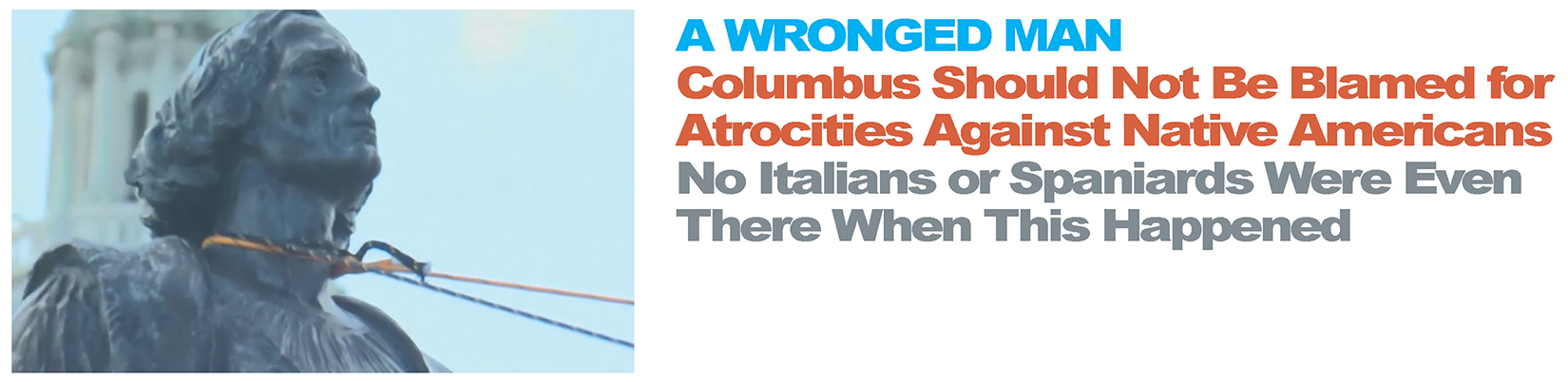
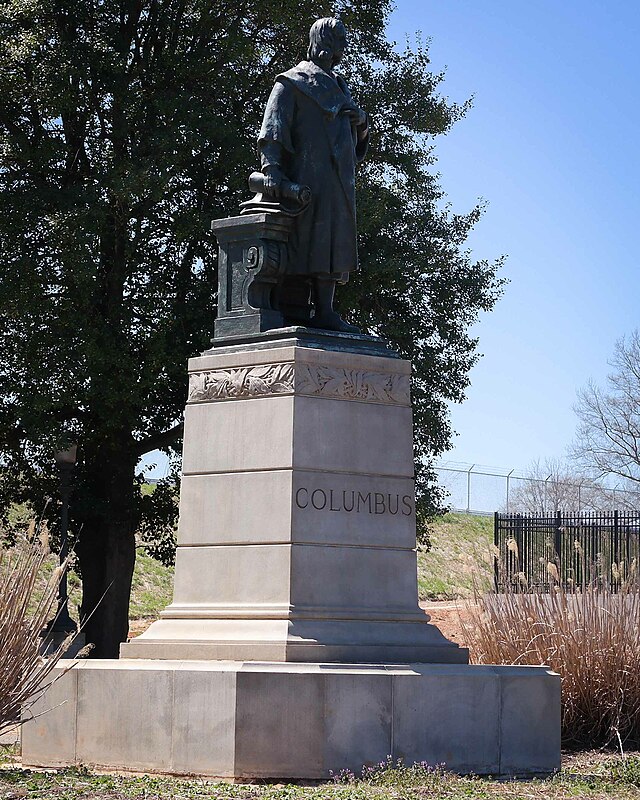
It was in Richmond where a group of young people did the bidding of the Ku Klux Klan: they lynched and ripped down the Columbus monument there. The statue was erected in 1927 in Byrd Park by Italian immigrants. Back then, the Klan had tried but failed to stop the public display of the artwork. Almost 100 years later, they succeeded by proxy after radicalized youth—none of whom were arrested or charged—razed the bronze edifice to dump in a nearby gulley.
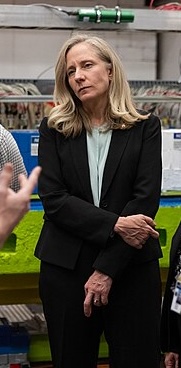
Now, the new governor of Virginia, Abigail Spanberger has joined the Columbus hate bandwagon. Almost immediately after getting sworn in on January 17, she disparaged Columbus and has all but promised to replace Columbus Day with Indigenous Peoples Day.
⸻
Enter IAOVC
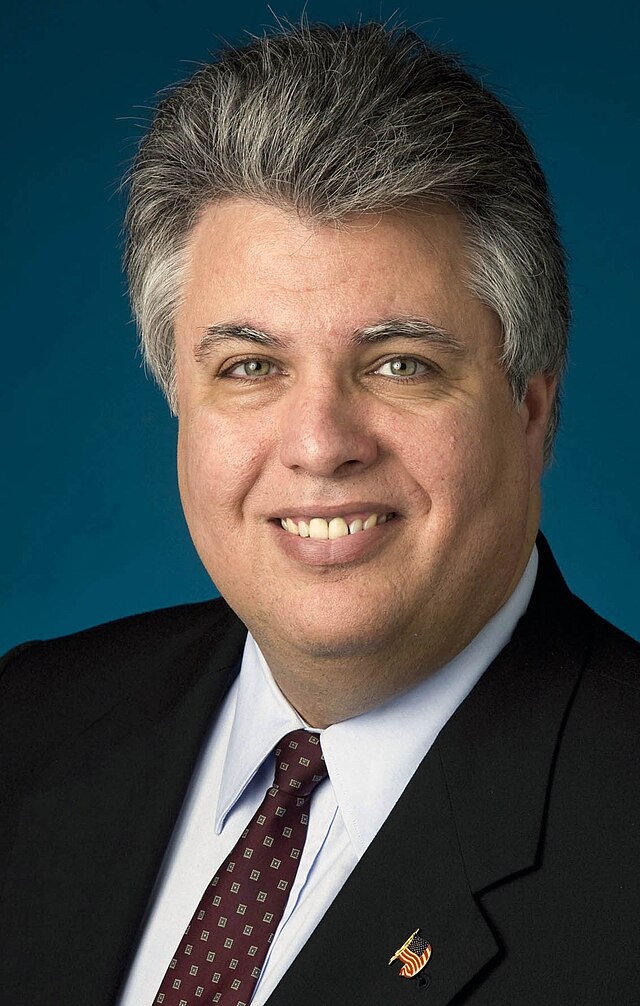
Enter the Italian American One Voice Coalition (IAOVC). The tireless Italian advocacy group, headed by André DiMino, has mobilized to stop her.
The organization released an open letter to Governor Spanberger to urge her to stop marginalizing Columbus Day—a holiday that Italian Americans view as inseparable from their own struggle for acceptance in the United States.
Christopher Columbus is as much a cultural symbol as he is a historical figure.
_____
From Persecution to Recognition
IAOVC made clear to Governor Spanberger that Italian immigrants were among the most despised and vulnerable groups in America. They faced demeaning caricatures, economic exclusion, segregated housing, and open violence. The most infamous example occurred on March 14, 1891, when eleven Italian Americans were hanged in New Orleans—the largest mass lynching in U.S. history.
The federal government’s response was not symbolic in hindsight; it was intentional at the time.
In 1892, President Benjamin Harrison proclaimed the first nationwide Columbus Day observance. The holiday was widely understood as an act of atonement—an acknowledgment that Italian immigrants had been wronged and that their place in American society required public affirmation. Columbus, already embedded in American historical mythology, became the bridge between a marginalized immigrant population and national recognition.
From that moment forward, Columbus Day took on a meaning far removed from maritime exploration. Columbus Day became a marker of arrival.
⸻
A Symbol That Evolved
The IAOVC letter emphasizes that Columbus statues and commemorations were never intended to deny historical complexity. Rather, they evolved into cultural touchstones representing dignity, survival, and acceptance for a community once treated as foreign and inferior.
For Italian Americans, the removal of Columbus monuments or the elimination of Columbus Day is not experienced as historical clarification but, instead, dismissal.
The IAOVC letter state: “Defending Columbus as an Italian American symbol is ultimately about defending the right of communities to honor their own journeys—to remember the pain, the progress, and the moments when America finally said, you belong here. That is why Columbus remains important. That is why his monuments matter. And that is why Columbus Day should continue to be preserved…”
History, the coalition argues, is not static. Symbols change not only because scholars reinterpret them, but because communities invest them with meaning. Columbus, in this sense, represents the moment when America finally told Italian immigrants: you belong here.
_____
The Cost of Erasure
Calls to abolish Columbus Day often frame the issue as a moral correction. But the IAOVC warns that removing ethnic symbols without regard for their cultural significance risks repeating an old pattern—silencing minority narratives in the name of progress.
“Don’t pit one group against another,” the letter urges. “Let’s celebrate Indigenous Peoples on their own day.”
More than a century after its creation, Columbus Day endures not because Italian Americans deny history, but because they remember it.
As stated by IAOVC: “That is why, on behalf of our IAOVC members across the country and all Italian Americans, we respectfully request that you cease your attack on our heritage and continue to celebrate Columbus Day - still a Federal Holiday - in Virginia.”
And that is why the debate over Columbus Day remains, at its core, a debate about who gets to decide which histories are worth preserving.
____
Editor’s Note: The photographs are of Virginia Governor Abigail Spanberger, IAOVC President Andre DiMino, the statue of Columbus in Richmond, before taken down. The photo of the Columbus was taken by "Smash the Iron Cage" from Wikimedia Commons.
The web site for the Italian American One Voice Coalition is https://www.iaovc.org
Be sure to be respectful and courteous when you email Governor Spanberger about you want to save Columbus Day in Virginia
mailto: mailto:Abigail.Spanberger@governor.virginia.gov
—————————————————————————————————————————————————————————————————————————————
Please visit our DVDs Page to shop our latest collection of DVDs on all things Italian: Films from Italy's Golden Age, Documentaries on Italian American life, ancient Rome, and religion.

Please visit our Books' page to review our latest inventory of books on all things Italian: cookbooks, history, art and culture.
Other articles to read...